S&P 500
Is Low Volatility A Warning?

Low volatility isn’t a bearish omen in and of itself, and we found stock market volatility levels to provide much near-term directional help.
Trading Volume Nothing To Worry About
We take a detailed look at the decline in trading volume and conclude the trend might be a positive going forward.
Sector Margins: Just Thank The Consumer
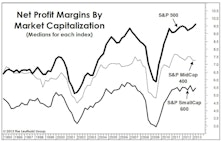
We’ve noted before that profit margin gains since the technology boom have been primarily a Large Cap phenomenon.
Market Internals: The Good And The Bad
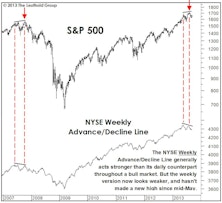
Leadership isn’t warning of impending weakness in either the U.S. economy or the stock market. Market breadth, on the other hand, is highlighting risks that aren’t evident when inspecting leadership alone.
Not Your Typical Bear Warnings...
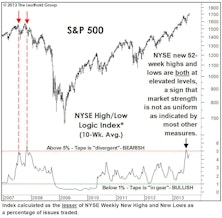
With July’s market surge producing new cyclical highs in virtually every important subgroup (other than Utilities), it’s difficult—if not dangerous—to question the U.S. stock market’s technical underpinnings.
“Immature” Market Behavior
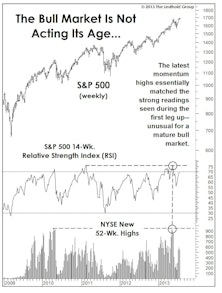
Whether one considers the post-2008 upswing two bull markets or one ultimately matters only to those who (like us) enjoy cataloging such things. But labeling the 2011-2013 rally a new bull market would certainly explain some of the “immature” behavior exhibited by U.S. stocks in recent months.
Fund Flows Still Not Quite As They Appear
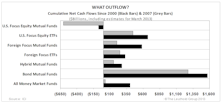
In this report we take an in-depth look at the evolution of the industry, particularly the U.S. mutual fund industry, to help understand how some fund flow trends are more of an indication of evolving investor preferences instead of an indication of retail investor sentiment toward a particular asset class.
Of Special Interest: Valuing The Stock Market - Do Interest Rates Matter?

Models based on so-called relative valuations have a poor track record in practice, having misled investors at several historic inflection points. Interest rates have virtually no impact on stock market valuations, but they may have transitory effects on stocks in the short term.
Everyone Gets A Trophy

It’s not just kids’ sports where the achievement bar has been lowered.
New Highs, And Then What?

We are in clear view of the “Twin Peaks” S&P 500 highs of the last decade and these should be eclipsed by mid-year. But when the S&P 500 is adjusted for inflation or denominated in Swiss Francs or Gold these highs may prove elusive.
A Peak At The Rear-View Mirror!
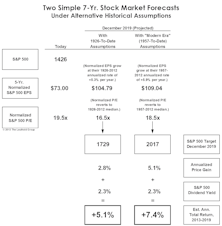
We’ve lately made it a January tradition to publish a “Rear View Mirror” forecast for S&P 500 returns out to the end of this decade.
An “All-Clear” Signal From Retailers?

Retail stocks barely paused during the September-November market setback, and have lately shot to new all-time relative strength (RS) highs. We were recently asked whether this bullish behavior was effectively an “inoculation” against falling into recession over the near term.
MTI Slips To Neutral… Now What?

While we don’t know which direction it will head next, we break down a few of the MTI categories and present some of our observations.
Bulls, Bears & The Buck

Our latest testing indicates that relative dollar stability provides the best backdrop for stocks.
Chasing Income That Barely Exists

Those adopting LDI today are doing so at the least opportune time in more than 60 years.
Bernanke’s Bad Timing

We can’t imagine what good could come from Ben Bernanke’s September 13th decision to resume money printing. What is the Fed going to do if another risk event hits and the S&P goes down 15-20%? Pray?
Thirty Percentage Points Of Pain…

The S&P 500 is now up 30% from last year’s October 4th low - a rally that surely ranks among the least enjoyable and least exploited gain of that magnitude in history.
Presidential Elections And Financial Assets

Does The Market Have A Party Preference In The Presidential Election? Results are a wash, so investors might rethink their assumptions about party affiliation and market performance.
Time For A Breather
The Major Trend Index has been bullish throughout 2012, and the S&P 500 has delivered a total return of +12% through early August. Yet few managers have managed to match or exceed that benchmark, to do so, they would have had to be “fully invested and maximum defensive.”
An “Old” Bull Market… That Should Get “Older”
The bull market is increasingly showing signs of advanced age, but that is only to be expected for a move that now measures 40 months off its March 2009 low.
Perception for the Professional
March 2026 Issue

Featured Articles
Sector Navigator
March 2026 Issue