GDP
Goldilocks & The Three Bears

Equity market resilience against war headlines, AI disruption fears, and private credit stress have so far been largely supported by a rare “Goldilocks” macro setup. Enter the three bears: Software stocks, private credit/BDCs, and bitcoin.
Fiscal “Juice?”
Not to pick a fight with Keynesians (or other economists), but we’re reluctant to label the explosion in the federal deficit as unequivocally “stimulative.” Some factors behind the increase probably do boost the economy, but others simply rob Peter to pay Paul.
Has The Stock Market “Eased?”
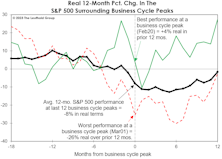
The path of real stock prices in the current cycle looks very different from the typical pre-recessionary track. In fact, based only on the chart of performance in real terms since January 2022, we’d probably believe the economy has recently emerged from recession.
1966-67: When The Yield Curve “Failed”
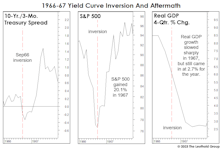
Given the tendency of economists and strategists to dismiss the message of an inverted yield curve, it’s surprising there’s been no scrutiny of the “dog that didn’t bark”—the inversion of 1966. That’s the last time an inverted curve did not lead to a recession.
Some Perspective For Dip Buyers
.jpg?fit=fillmax&w=222&bg=FFFFFF)
Losses in the Russell 2000 Growth Index and the NYFANG+ Index have topped 40%, and the only true equity rockstar, spawned by a 13-year secular bull market, has watched her fund’s value drop by more than three-quarters. Yet there’s still a televised debate as to whether this decline is even a bear! Could there be a more devious creature on the face of the planet?
Time To Start Thinking About “Thinking About…”
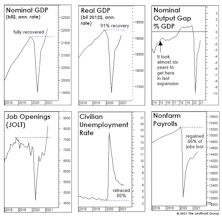
The COVID collapse showed the Fed could abandon its clunky forward guidance and make the appropriate “pivot” when the facts changed. Now that facts have changed for the better, the Fed is right back to the rigid and dogmatic approach that characterized Fed-speak for almost all of the last economic expansion.
The Case For “Five Percent”
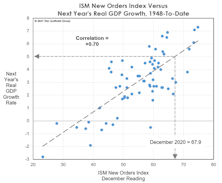
Forecasting GDP is hardly our forte, but 2021 should see a very big gain in real output. Our current guess is for real GDP to grow 5% this year. Statistically, though, that doesn’t imply that the stock market’s move will also be large (or even of the same “sign”).
Margins Prove Capitalism Still Works
.jpg?fit=fillmax&w=222&bg=FFFFFF)
Corporate profits were outstanding last year, but even the benefit of a 40% cut in the top income-tax rate wasn’t enough to lift the net profit margin back to the all-time high of 10.6% established in early 2012. Still, the latest 10.0% figure is more than a percentage point above the 2007 cycle high and about two points better than any other cycle high.
Watch What They Do, Not What They Say
While the celebration over Jerome Powell’s “Christmas Capitulation” lingered throughout February, we’re still awaiting signs the capitulation consisted of anything more than words.
Yields Might Be Throwing A Curve
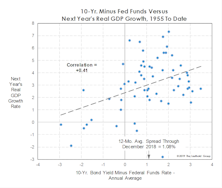
While the number of recession forecasts is on the rise, there’s a general reluctance among economists to project a downturn in the absence of a yield curve inversion.
The Gap Is Back!
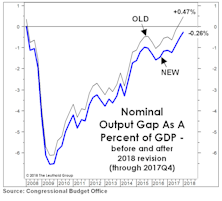
We celebrated the official closure of the GDP Output Gap in December, but that milestone was revised away in April by the statisticians at the CBO through a downward adjustment to the estimated rate of “full employment.”
Cashing In On The LEI?
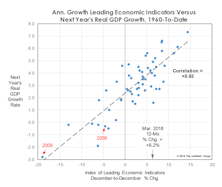
The consensus view is that the stock market will be fine as long as there’s no recession in sight.The same LEI that has displayed a fine GDP forecasting record has shown essentially no relationship with S&P 500 forward twelve-month performance. In fact the regression line shows a slight negative slope!
Not A Tipping Point, But A “Toggle” Point?
Evidently, being a bull in a bull market is no longer good enough.
Below “Stall Speed”?
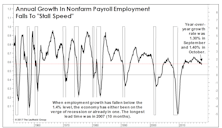
The last few months have served up some of the strongest readings observed during the U.S. economic expansion.
Don’t Look Now, But...
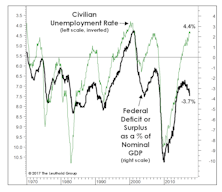
We recognize it’s uncultured to discuss federal debt and deficits during a multi-year bull market, but in economics and investing it frequently pays to worry when others don’t, and to stop worrying when others do.
Earnings: What Is Normal?
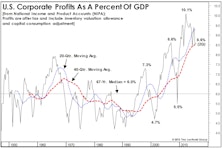
Corporate profits are notoriously cyclical, and for decades we’ve sought to temper their swings by using a five-year smoothing of S&P 500 EPS in our valuation work.
Searching For Growth In Emerging Markets
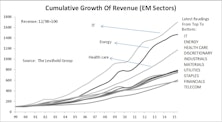
Even though the ten EM sectors are growing at a much stronger pace than corresponding U.S. sectors on the Top-Line, only a small margin exceed the U.S. in terms of EPS growth.
A Look At The Impact Of Lower Energy Prices On Countries
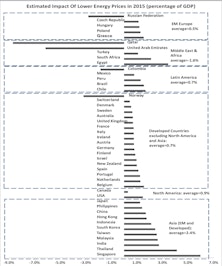
A big question for investors is: have oil prices bottomed? For the past four days, WTI jumped 19% from its low reached on January 28th, giving some the conviction that prices are reverting back to prior high levels.
Corporate Profits In 2014
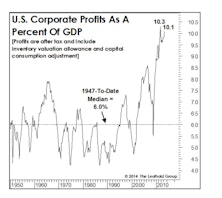
Earnings growth over the next few years will—in the best case—be forced down to the rate of top-line growth (nominal GDP).
Stocks And The Dismal Science
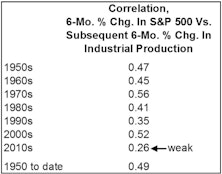
Has recent Fed experimentation compromised the stock market’s “social function” as an economic forecasting tool?
Perception for the Professional
March 2026 Issue

Featured Articles
Sector Navigator
March 2026 Issue