China
Top Charts Of 2025 & Persistent Themes For 2026

2025 was a year where “abnormal” became the new normal. From fiscal dominance and stubborn inflation risks to renewed credit stress and a shifting global leadership map, our favorite charts from the past year reveal the forces likely to shape markets in 2026—and where the next opportunities and risks may lie.
China’s “Whatever It Takes” Moment—“Believe Me, It Will Be Enough”

Market reaction to the latest flood of monetary and fiscal stimuli has been spectacular. While conviction about Beijing’s attempts to revive its flagging economy has been severely lacking, this time we should believe it. It’s certainly the right medicine China needs and the spark of confidence these actions will ignite should not be underestimated.
Three Themes To Watch—An Update
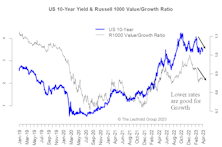
The Value/Growth dynamic seemed to indicate a return to the “lower rates are good for Growth stocks” regime. China reopening is still alive and well, despite a recent pause. The GSCI Industrial Metals/Gold ratio has broken below its recent range, which bodes ill for inflation expectations going forward.
Three Themes To Watch

The China-reopening theme is alive and well, which will likely support cyclical outperformance. The disinflation trade is at a crossroads. Value/Growth started to decouple from interest rates.
China—See The Policy Forest Through The Tree (Diagram)

There has been a torrent of new policies coming out of China recently. The goal of this report is to disentangle these seemingly random or even nonsensical policy moves and present a clearer roadmap of what China is thinking and doing.
Emerging Markets EPS: There's Many A Slip...

If there is one thing sure to make equity investors swoon, it is the prospect of buying into a credible, long-lived secular growth story at a relatively modest valuation. Over the past three decades, Emerging Markets (EM) have proffered just such an opportunity. EM’s economic growth rates have far surpassed those of developed nations, and the valuations attached to EM stocks have often been at a discount to other markets.
However, this combination of secular growth and attractive valuations has not always paid off for investors. The MSCI Index has underperformed the U.S., Europe, and even Japan over the last ten years in local currencies. Furthermore, EPS growth for the EM Index has come in far below its economic growth rate, creating an exasperating drag on Index performance as it tries to keep up with other regions.
That Money Tsunami Is Now Just A Flood
Compare the U.S. monetary response in early 2020 to China’s: The Fed quadrupled the M2 growth rate (from 6% to 24%) in three months, while China merely bumped M2 growth from 8% to 11%. This relative policy restraint leaves China in a better position to handle potential fallout than if it had gone “all in” like the U.S.
Research Preview: Emerging Markets’ Leaky Bucket

Investors view Emerging Markets (EM) as the best source of economic growth across global equity markets, and rightly so. Annualized EM GDP growth of 8.6% since 2001 is more than double that of the U.S. and Europe. However, investors have not captured this extraordinary advance because earnings per share for the MSCI EM Index have lagged far behind EM economic growth rates.
Coronavirus—An Accelerator, Not A Catalyst
Chinese and Hong Kong markets are currently following the same script as seen during the SARS outbreak, but we caution against using S&P 500 performance as a guide for what is likely to happen this time around.
恭喜发财- Red Envelopes From The Fed & PBoC

A significant policy move by China’s People’s Bank of China (PBoC) has gone largely unnoticed.
MSCI EM Reclassification: Achiever & Aspirers
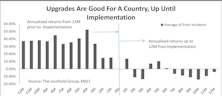
EM segments on the “Aspirer” watch list for MSCI annual market reclassification: China A-shares and Argentina. The “Achiever,” Pakistan, just recently started trading as a new member of MSCI EM Index.
“Index Rebalance Effect” Once Again Proven
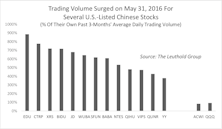
Validating results of a prior study, a look at the last four MSCI index rebalances shows that stocks soon to be added outperform from Announce Date to Effective Date, while deleted stocks underperform.
Update: U.S.-Listed Chinese Companies Going Private

An update on a topic we’ve covered twice before—the wave of U.S.-listed Chinese companies that were mulling over going private. Because of relatively large discounts to offer prices, the taking-private targets represent a unique lower-risk investment opportunity.
MSCI To Include Foreign-Listed Chinese Stocks For First Time

MSCI will soon announce the results of its semi-annual index rebalance and, for the first time, overseas-listed Chinese companies will be included in the MSCI Emerging Market and China Country Indexes.
Chinese Economic Concerns Are Overdone

The traditional economic indicators are no longer as relevant as people think, and China’s condition may not be as bad as most fear.
Emerging Markets: A Half-Off Sale!

The Chinese government’s repeated stock market intervention attempts over the past several weeks have been remarkable, and obviously antithetical to the country’s move toward a more laissez faire corporate environment.
Chinese Equity Market: Valuation Gap And Going Private

The recent capitulation of the Chinese domestic equity market (or A-shares) makes headlines almost every day. Different theories, circulating in both China and overseas, pop up frequently to explain the daily movement of A-shares. It seems the investment community gets excited when the Chinese market is on the decline (but not so much when the market is on the upswing); many investors are quite reactive to any negative news coming out of China.
China A-Shares: Market Getting Too Hot?

Our long term view towards China is positive (especially relative to other large EM countries), but short term, we see signs of the A-shares segment overheating and caution against near term corrections.
Declining Crude Prices Good For Emerging Markets?

The price of crude oil staged a dramatic change of fate in the past few months, and the bottom is still nowhere in sight.
Chinese Stocks: Accounting Red Flag Screen

We examine several models or screens to detect accounting or governance risks.
Perception for the Professional
March 2026 Issue

Featured Articles
Sector Navigator
March 2026 Issue