Federal Debt/Deficit
Has The Tsunami Of Stimulus Been Worth It?
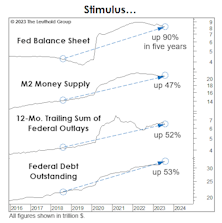
Federal outlays, federal debt, and M2 have each jumped ~50% in five years, while the Fed’s balance sheet soared by 90%. The “reward”: Real GDP cumulative growth per capita of 1.6% per year (a good chunk of which will be reversed during a recession).
Fiscal “Juice?”
Not to pick a fight with Keynesians (or other economists), but we’re reluctant to label the explosion in the federal deficit as unequivocally “stimulative.” Some factors behind the increase probably do boost the economy, but others simply rob Peter to pay Paul.
What “Causes” Inflation To Decline?
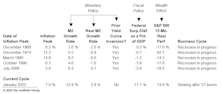
Last year’s consensus view that inflation would prove “transitory” missed the mark. There’s no reason for shame; inflation forecasting hadn’t been a required investment skill for the previous 30 years.
Fat Profit Margins? Thank Your Grandkids!
Future generations are now footing the bill, not only for today’s entitlement recipients, but for record corporate profits as well! (Consider a gift of QQQ shares to help them pay for it all.)
The Stock Market IS A “Fundamental”
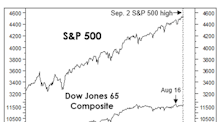
The impact of U.S. stock-market “hegemony” extends far beyond currency markets. We believe the mania has progressed to the point where the stock market itself will shape the intermediate-term and even long-term fortunes of the U.S. economy more than it ever has before.
Why The Fed Is Hog-Tied

We’ve long considered ourselves lucky to have escaped from our graduate-economics program after only a year. Among the few nuggets we managed to retain was the startling conclusion to a paper written by a famed department professor asking, “Do Large Deficits Produce High Interest Rates?”
Measuring The Cost Of “Free”
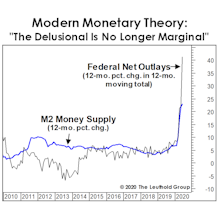
The S&P 500 and NASDAQ have lately traded as if the hybrid “Fed/Treasury put” entails no cost at all. But dollar alternatives—like forex, precious metals, and crypto-currencies—are saying, “Not so fast!”
A Bear Market In Price, But Not Time
We have a hard time accepting that the excesses associated with an eleven-year bull market and expansion can be fully expunged in 27 trading days, no matter how ugly those days were… keep some powder dry!
Real Rates and the Federal Deficit

The real short-term interest rate shows how inappropriately-loose monetary policy has remained in the face of a steady economic expansion.
Real Rates And The Federal Deficit

We previously mentioned the increasing focus on the real short-term interest rate as an important measure of the Fed’s policy stance. In truth, we wish the Fed had paid more attention to this measure during this cycle.
Don’t Look Now, But...
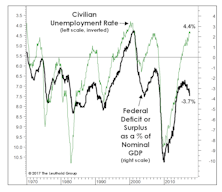
We recognize it’s uncultured to discuss federal debt and deficits during a multi-year bull market, but in economics and investing it frequently pays to worry when others don’t, and to stop worrying when others do.
Policymakers’ Shell Game

We considered the launch of the QE tapering program in January 2014 as the formal onset of the Fed’s tightening campaign, and that view seemed to be on the mark when High Yield bonds, and then stocks, unraveled over the next couple of years—although the final losses in the DJIA and S&P 500 fell short of what we expected.
Longer Term Concerns About U.S. Debt And Deficit

$4.8 trillion of the additional $9 trillion in debt that Uncle Sam is expected to incur over the next decade is interest obligation.
“Just Another” Soft Patch

MTI studies of market values, investor psychology and price action have (so far) overwhelmed the economic “elephants in the room.” A few thoughts on those elephants.
Longer Term Concerns About U.S. Debt And Deficit

More than one-half of the U.S. government’s additional $9 trillion in debt expected over the next ten years is projected to be interest. This is a frightening proposition.
The Bond Bubble Is Beginning To Deflate… Is The Cheap Money Era Ending?

The bond bubble is deflating, as investors demand higher yields to compensate for expected rising inflation and the U.S. mountain of debt.
The Bond Bubble Is Beginning To Deflate… Is The Cheap Money Era Ending?

We raised most of our twelve month yield targets this month, based on higher inflation expectations and U.S. debt concerns. Extremely low yields at the short end of the curve are the result of a stimulative Fed policy. Rising yields at the long end of the curve reflect rising inflation expectations.
Is The Bond Bubble Beginning To Deflate?

The bond bubble could be deflating, as investors demand higher yields to compensate for expected rising inflation and the U.S. mountain of debt.
Is The Bond Bubble Beginning To Deflate?

Bond bubble continues to inflate, much like money pouring into tech stocks at the height of the internet bubble.
Longer Term Concerns About U.S. Debt And Deficit

The kneejerk reaction to worries about excessive sovereign debt has been to bail out of the European sovereign debt and pile into U.S. sovereign debt. Unless the U.S. can get its own fiscal act together, we may face this same panic reaction farther down the road.
Perception for the Professional
March 2026 Issue

Featured Articles
Sector Navigator
March 2026 Issue