Federal Debt/Deficit
Are We In A Bond Bubble?

Bond bubble continues to inflate, much like money pouring into tech stocks at the height of the internet bubble.
Longer Term Concerns About U.S. Debt And Deficit
The kneejerk reaction to worries about excessive sovereign debt has been to bail out of the European sovereign debt and pile into U.S. sovereign debt.
Longer Term Concerns About U.S. Debt And Deficit

A mountain of new debt, a balloon of short term borrowing due near term, and the likelihood of higher interest rates are big hurdles.
Longer Term Concerns About U.S. Debt And Deficit

A mountain of new debt, a balloon of short term borrowing due near term, and the likelihood of higher interest rates are big hurdles. Moody’s says U.S. debt could test its AAA rating.
Longer Term Concerns About U.S. Debt And Deficit

A mountain of new debt, a balloon of short term borrowing due near term, and the likelihood of higher interest rates are big hurdles. Moody’s says U.S. debt could test its AAA rating.
Longer Term Concerns About U.S. Debt And Deficit

A mountain of new debt, a balloon of short term borrowing due near term, and the likelihood of higher interest rates are big hurdles. Moody’s says U.S. debt could test its AAA rating.
Longer Term Concerns About U.S. Debt And Deficit

We continue to have longer term concerns about U.S. debt and deficit. The mountain of debt is building and interest expense rising.
Longer Term Concerns About U.S. Debt And Deficit

Jim Floyd’s analysis of the interest costs facing the U.S. due to the soaring budget deficits.
Fall Into Deflationary Territory Should Be Short Lived

Compared against very deflationary readings in the second half of 2008, PPI could finish 2009 up +2.0%. The worst of the commodity price downdraft should be behind us.
Decline Into Deflationary Territory Could Be Short Lived

2008 was a deflationary year for the PPI (–1.2%). 2001 was the last calendar year with deflation (-1.8%), and it was also a recession year.
Recent CPI and PPI Readings Declined By Largest Percentages In Over 60 Years

Currently declining energy and other commodity prices are producing some significant “down” months for CPI and PPI.
Outlook: Weak Economy, Inflation Decelerating

The consumer is in the worst shape that we can remember. September job loss was the highest in five years.
Outlook: Weak Economy, Inflation Decelerating

Revised Q4 real GDP confirms what we’ve been saying for quite some time...the U.S. economy began contracting in Q4 2007.
Inflation Understated Not Overstated

There is political pressure to keep inflation low, minimizing COLA (cost of living adjustments) and Social Security costs. Low inflation also helps to keep interest rates down, which keeps government interest payments as low as possible.
Deficit Watch...Outlook Worsening

The U.S. economy is slowing and probably fell into recession in Q4 2007
Current Stock Market Strategy

Market has so far performed pretty much as expected. Major Trend still Negative, but recent improvement is surprising. Bear market could be winding down.
Jobs/Consumer Data Flashing Recessionary Signals

Optimists have continuously cited low unemployment and the ever resilient U.S. consumer as two “pillars of strength” that will help keep the economy afloat. It has become considerably more difficult to make this case in recent months, as jobs and spending data have weakened to levels associated with recessions.
Worth Noting???

What follows are my personal observations and opinions. I am an anti-inflation fiscal conservative and I know some would add “curmudgeon” to this description.
U.S. Economy Skirts Recession In Q4, Or Does It?
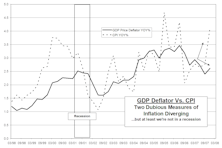
It now appears that the downward bias in inflationary pressures suggested by the CPI data is tame compared to the GDP Deflator. And if this is true, investors may be operating under a false sense of security that economic growth remains positive (albeit ever so slight).
Fed’s Favorite Inflation Measure Now Well Above Fed’s Preferred Range

The notion of a core rate of inflation (excluding Food and Energy) seems to be fading away—finally!
Perception for the Professional
March 2026 Issue

Featured Articles
Sector Navigator
March 2026 Issue