Performance
The Easy Fed and the “Other” Inequality
.jpg?fit=fillmax&w=222&bg=FFFFFF)
Super-easy monetary policy has been blamed for the rise in income and wealth inequality in recent years, and more recently we’d fault the Fed for performance inequality within the stock market.
Taking A Punt On U.K. Stocks?

The June 2016 Brexit referendum kicked off a tortured process for the United Kingdom to leave the European Union. However, the wheels of international politics turn slowly, and the original date of formal withdrawal was set as March 29, 2019. As the calendar rolled into 2019 it became obvious that the March closing date was not going to be met, and concerns mounted over delays, procedures, deal-or-no-deal, a new prime minister, and even calls for another vote.
Worrisome Profitability Trend Among Small Cap Companies
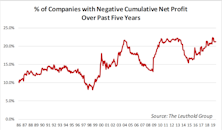
Despite a historic economic expansion during the past decade, there is an ever-increasing number of companies that are finding profitability has become harder to achieve.
Sector Concentration And Effects On Country Performance
Is the performance of certain countries mainly driven by particular sectors? And, does U.S. sector performance drive the performance of other countries? (i.e., when U.S. Financials underperform, do foreign countries with large Financials sector weights underperform?). We did some data crunching to address the second question.
“De-Worsification” Ruled In 2018!
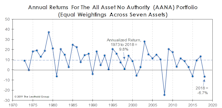
The market difficulties of 2018 were hardly limited to stocks. Commodities, in fact, were the worst performer among the seven major asset classes.
3% Yields Proved To Be High Enough

In September the popular claim was that “interest rates were rising for the right reasons,” and still too low to threaten stocks or U.S. economic expansion.
Narrow Performance Divergence Among EM May Not Last
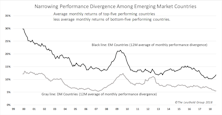
We’ve previously noted the narrowing performance divergence between top- and bottom-performing Emerging Market (EM) countries in recent years.
Research Preview: Sector-Adjusted Factor Returns
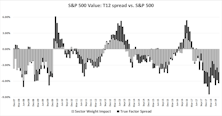
This article summarizes our current research into the interaction between factors and sectors. We find that sector weights have a significant influence on some factor results, while the true factor impact is the key driver for others. Watch for our full report coming next week.
What’s Ailing The Staples?
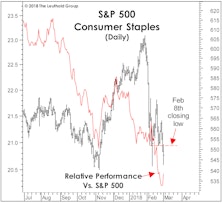
The setback that began in late January qualifies as the sixth intermediate correction of the current bull market, where “intermediate” is defined as an S&P 500 loss ranging between 7%-12%...
Recessions & The Stock Market
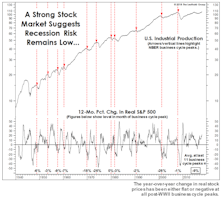
In the last couple of months, we’ve come across a handful of economic “check lists” purporting to show the relative absence of recession harbingers as the expansion closes in on its ninth anniversary this summer.
Bridesmaid Strategy: Picking The Year’s Best Asset
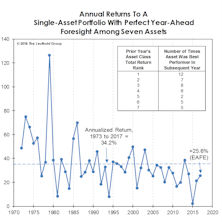
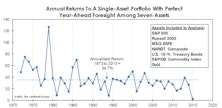
Here’s another way to look at the persistence of momentum across asset classes for the last 45 years.
A Study On Closed End Funds
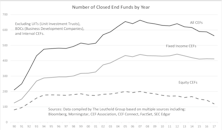
In March 1991, an article titled “Investor Sentiment and the Closed-End Fund Puzzle” was published in The Journal of Finance.
The Intelligent Use Of Smart Beta
Quantitative investing has become an integral component of professional investment management, and smart beta funds have become popular vehicles for advisors as they assemble actively-managed client portfolios.
Quantitative Factor Performance: Year In Review
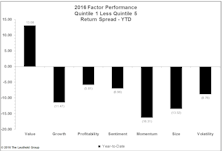
Factor performance during 2016 is the reverse of that of 2014-2015. Quants and smart beta funds focusing solely on Value have enjoyed the year, while multi-factor approaches have struggled. Value has been the only factor that has provided positive performance this year.
Not Much “Lift” From VLT “BUY”
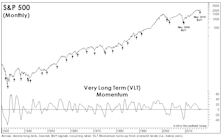
In the June Green Book, we professed some skepticism surrounding the long-term, “low-risk” BUY signal for stocks that was triggered at the end of May by our Very Long Term (VLT) Momentum algorithm (also known as the Coppock Curve).
“Index Rebalance Effect” Once Again Proven
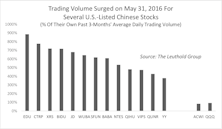
Validating results of a prior study, a look at the last four MSCI index rebalances shows that stocks soon to be added outperform from Announce Date to Effective Date, while deleted stocks underperform.
The Fed’s Capitulation To The Dovish Side— A Win-Win For EM & U.S.

We have mentioned a number of times that China had experienced a very unpleasant “second-hand” tightening due to its peg to the dollar. Its trade competitiveness has suffered tremendously. With a weaker dollar the Chinese Yuan can re-gain some of its competitiveness while maintaining its peg to the dollar. A rare win-win in today’s convoluted world of finance.
Asset Allocation: No Upside In 2015
Hedge funds have shuttered by the dozen in the past few weeks, with the worst carnage among those focused on Emerging Markets and commodities. But the problem is broader.
The Pause That “Depresses”?

The blue chip U.S. indexes have gone nowhere in 2015, and we expect bulls will soon write off the year as the “pause that refreshes.” But what’s been refreshed?
New Month, Old Worries...

While the S&P 500 had erased all but 2% of its August loss as of early December, Small Caps and the “average stock” had recouped only about half their correction losses. Not good.
Perception for the Professional
March 2026 Issue

Featured Articles
Sector Navigator
March 2026 Issue