Fund Flow
Reditus Emptor Caveat
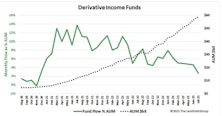
Despite skyrocketing investor enthusiasm, buy-write strategies are complicated investments with skewed payoff structures that muddle the interpretation of past performance, because returns depend on market conditions.
Land Of The Rising Stock
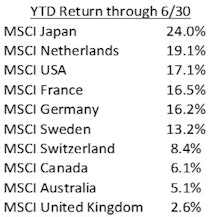
After years of wandering in the wilderness, Japanese stocks are leading the world’s developed markets higher in what has been a robust opening half of the year. The table shows Japan leading the world’s ten largest developed markets (as measured by the MSCI family of international indexes) with a 24% local currency return through June, easily outpacing the pack. Even as the MSCI USA index gained 17% by successfully “fighting the Fed” this year, Japan surged another 7% beyond that outstanding result. We were curious to understand the nature of Japan’s spectacular run in 2023, looking to identify the drivers of this strong and relatively quick jump higher.
ETFs Evolving: Make Mine Mint Chip

The ETF concept began as a vehicle to provide low-cost access to a broad market index, and the terms “passive”, “cheap”, “index”, and “ETF” were often used synonymously. However, ETFs soon evolved into specialty funds that allowed investors to take focused active tilts in sectors, styles, and countries; a landmark shift away from the notion of passively investing in the total market. These specialty funds are easy to trade and tax efficient, but they do not fall under the labels of cheap, passive, or broad market.
Newfound Popularity Of Thematic ETFs
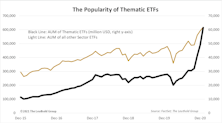
We’ve noticed a small segment of equity ETFs, designated as “thematic,” that is increasingly gaining popularity. Thematic ETFs invest in baskets of stocks that share narrowly-defined business enterprises outside of the standardized GICS methodology.
Carbuncles, Diamonds, and Tears
.jpg?fit=fillmax&w=222&bg=FFFFFF)
High growth rates, innovation, and disruption are defining traits of the companies that have powered the market to recent highs, and the ARK Innovators Fund (ARKK) is an example of today’s enthusiasm for visionary growth stocks. Recent returns and growth in AUM have been nothing short of spectacular, and ARKK has become symbolic of today’s style of new-era growth investing.
The Relationship Between ETF Fund Flow & Future Returns
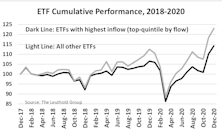
In April 2018, armed with a large number of ETFs and long-enough historical data, we applied our back-testing methodology for individual stocks to the universe of ETFs to determine if the same (or some) of those components could useful for assessing ETF performance prospects. One of the factors we reviewed was fund flow (adjusted by AUM), which revealed that those ETFs experiencing the largest asset inflows proceeded to significantly underperform.
The “Pfizer Factor Flip” And Fund Flows
.jpg?fit=fillmax&w=222&bg=FFFFFF)
Pfizer’s November 9th announcement of an effective COVID-19 vaccine triggered the most extensive one-day rotation in style factors we have ever seen. Investors flipped from Large Growth—the market’s dominating style over the past few years—and found new friends in Value and Small Cap. This rotation continued through November, to the point that Value and Small Cap each had their best single-month return in 30 years.
Five Reasons To Expect Higher Yields

Much of what we think “we know” about the bond market says yields should be headed higher.
Shun ETFs With Largest Inflows

We found that ETFs with the largest one-month, two-month, and three-month fund inflows underperformed going forward. When further broken down by sub-asset class strategies, this pattern is pronounced among equity ETFs, while fixed income ETFs do not appear to be affected by fund flows.
Stock/Bond Market Fund Flow Trends
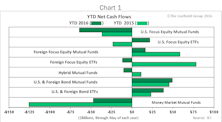
Bond funds (including ETFs), foreign-focused equity mutual funds and domestic-focused ETFs are the only categories capturing positive cash flows YTD.
Cash Left The Sidelines Long Ago

The “cash on the sidelines” is a Supply/Demand argument that we’ve struggled with even in the most bullish of times; every purchase of a security is matched with a sale. But even taking the argument at face value, current holdings of retail investors and mutual fund managers suggest that the cash left the sidelines long ago.
Domestic Equity Mutual Funds and Bond ETFs See Weekly Net Outflows.

Within two broad categories – domestic equity funds and bond funds - mutual funds versus ETFs continue to display opposite flow trends.
YTD Bond Mutual Fund Flows Top 2013 Comparator

Bond mutual funds continue to capture net inflows while their ETF counterparts have seen net outflows for three straight weeks. Domestic equity mutual funds see more net outflows, but (barely) hang on to positive YTD flows.
Bond ETF Net Outflows Accelerate

Bond ETFs, Domestic Equity Mutual Funds and Money Market Funds see weekly net outflows, while all other broad categories experience net inflows.
Domestic Equity MF Flow YTD Highest Since 2006

Aside from money market funds, cash flowed on a net positive basis to all broad fund categories this week. Domestic equity mutual funds saw an estimated $1.2 billion in net inflows, on the heels of two weeks of outflows.
Outflows From Equity & Bond Funds

Outflows From Domestic Equity & Bond Funds Continue; Foreign-Focus Funds Still See Inflows.
Second Week of Equity Fund Outflows

Net cash outflows from bond mutual funds are not letting up; we've seen fund outflows in 25 of the past 27 weeks, with this week's estimated net outflow at $5.6 billion.
2013’s Fund Flow Trends Have Room To Run
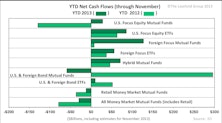
Year-to-date, equity funds are cash on par with those of the 2000 tech bubble, while bond mutual funds are experiencing net cash outflows for the first time in a decade.
Target Date Funds Impacting Industry Fund Flows

Funds of funds, particularly target date funds, are growing rapidly and are now large enough to have a measurable impact on underlying fund flow trends.
Strongest Net Outflows From Bond Funds In Years

Most noteworthy this week was a combined estimated $13.5 billion exiting bond mutual funds and ETFs on a net basis.
Perception for the Professional
March 2026 Issue

Featured Articles
Sector Navigator
March 2026 Issue