CPI
Mild Deflation Short Term… Mild Inflation Next Twelve Months

This transition from deflation to mild inflation will be a “numbers game,” as 2009 readings are compared against 2008’s second half deflation, driving current twelve month readings up
Mild Deflation Short Term… Mild Inflation Next Twelve Months
The greatest danger in late 2010 and 2011 is monetary debasement inflation, not demand based inflation. Trillion dollar deficits (or higher) may be acceptable shorter term (2009), but unless our government and politicians provide strong evidence of fiscal responsibility, the dollar’s respectability could be undermined, with foreign lenders and investors going elsewhere.
Mild Deflation Short Term… Mild Inflation Next Twelve Months

The greatest danger in late 2010 and 2011 is monetary debasement inflation, not demand based inflation. Trillion dollar deficits, and higher, may be acceptable shorter term (2009), but unless our government and our politicians provide strong evidence of fiscal responsibility, the dollar’s respectability could be destroyed with foreign lenders and investors going elsewhere.
Expect To See Rising CPI/PPI Inflation As Economy Recovers

Rising food and energy prices will more than offset deflationary CPI housing subset, ultimately driving the twelve month CPI rate to +3.6% by mid 2010.
Expect To See Rising CPI/PPI Inflation As Economy Recovers

As the global economy recovers in 2010, we expect the PPI twelve month rate to accelerate to +5% as commodity prices continue to rise.
Fall To Deflationary Territory Should Be Short Lived

As first half of 2009 readings compare against inflationary 2008 first half readings, the twelve month rate will sink further into deflationary territory, probably to around –6%. But the second half of 2009 will be a different story, as commodity prices could continue to rebound or at least stabilize (anticipating economic recovery).
Fall Into Deflationary Territory Should Be Short Lived

CPI/PPI inflation readings are expected to dip into deflationary territory in the first half of 2009.
Fall Into Deflationary Territory Should Be Short Lived

Compared against very deflationary readings in the second half of 2008, PPI could finish 2009 up +2.0%. The worst of the commodity price downdraft should be behind us.
Decline Into Deflationary Territory Could Be Short Lived

2008 was a deflationary year for the PPI (–1.2%). 2001 was the last calendar year with deflation (-1.8%), and it was also a recession year.
Recent CPI and PPI Readings Declined By Largest Percentages In Over 60 Years

Currently declining energy and other commodity prices are producing some significant “down” months for CPI and PPI.
Outlook: Weak Economy, Inflation Decelerating

The consumer is in the worst shape that we can remember. September job loss was the highest in five years.
Outlook: Weak Economy, Inflation Decelerating

Revised Q4 real GDP confirms what we’ve been saying for quite some time...the U.S. economy began contracting in Q4 2007.
CPI Expected To Decelerate

CPI inflation measured on a twelve month basis has probably peaked. Looking ahead, inflation should cool off in the first half of 2009 (+3%). Here’s why....
CPI Expected To Decelerate To +5% By Year End

CPI Inflation measured on a twelve month basis may be close to a cyclical peak.
Commodity Curtain Call?

Inflation is peaking and the GS Scores did a great job signaling an exit from the Industrial Metals play. Commodities were hit hard in July.
The GDP Report: “Exhuming McCarthy”
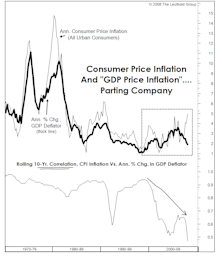
Significant disconnect between GDP Deflator and CPI. Recent GDP report implies a 1.1% inflation rate. It is ridiculous to assume the inflation rate is that low with the CPI at +5.5%.
CPI Expected To Peak Near +5.5%

Inflation should be cooling off as the U.S. economy contracts and global economies show signs of slowing.
CPI Inflation Expected To Reaccelerate

As U.S. and global economies slow, inflation should be cooling off. However rising food and energy prices are keeping CPI and PPI measures uncomfortably high.
Inflation Falls During/After Recessions, But Maybe Not This Time
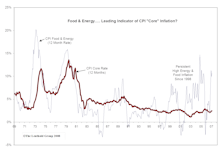
There is a strong linkage between higher Food and Energy costs and “Core” CPI, as these higher prices filter directly to the so-called “Core” CPI categories. If Food and Energy prices remain strong we could see a reacceleration in CPI inflation this fall.
Economic Watch
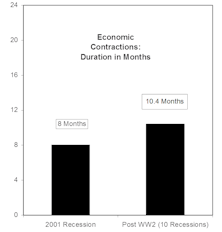
Even though government statistics do not yet indicate a declining quarter of real GDP growth, we believe we are, in fact, in the grip of a recession.
Perception for the Professional
March 2026 Issue

Featured Articles
Sector Navigator
March 2026 Issue