Bear Market
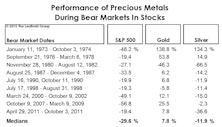
Equal Opportunity?
While the Major Trend Index, at 0.90, is now in its negative zone, it’s not as if all the traditional bearish bellwethers have lined up in a row (… then again, they never do).
How Long Can Small Caps Lead?
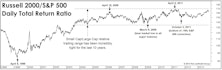
The Russell 2000 is about five points ahead of Large Caps YTD, and is approaching its April 2011 long-term relative peak. We view this outperformance as their leadership’s last gasp and not a new cycle.
Little To Complain About
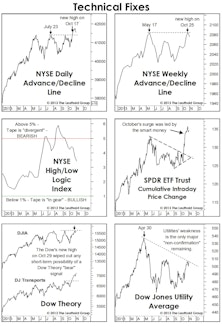
From a pure price action perspective, it’s difficult to find cracks in the bull market’s edifice.
Industry Groups: No Need To Bottom-Fish
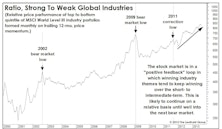
Buying global groups with strong price momentum has been a winning strategy. Will it continue?
An “Old” Bull Market… That Should Get “Older”
The bull market is increasingly showing signs of advanced age, but that is only to be expected for a move that now measures 40 months off its March 2009 low.
Major Trend Bending, But Not Breaking...
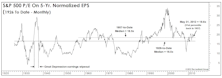
The April/May swoon (an S&P 500 loss of -9.9%) has been accompanied by significant deterioration in our Major Trend Index. But the latest reading (data through June 1st) stayed positive, and our best guess is that it will hold firm.
The Bigger The Bear, The Better The Bull?
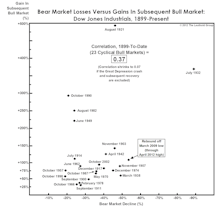
Does a bigger Bear market equate to a bigger Bull market recovery?
Start Of A New Bond Bear Market Or Not, There Is No Need To Rush
Whether it’s the start of a new bond bear market or not, there’s no need to rush... and why shorting bonds may not be the best idea, even during a bond bear market.
New Bull Market - Or Up-Leg In An Old Bull?
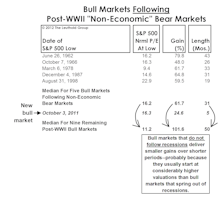
Bull markets following economic versus “non-economic” bear markets—what’s the difference?
Ain’t Nobody Happy
Despite the big October rebound, Doug Ramsey examines various market players and finds that dissatisfaction with recent market moves may proliferate among all but a select few.
Worse Than It Looks… And Not Over
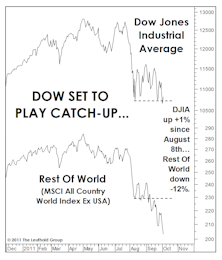
Most costly market decoy in the last six weeks has been unusual (relative) strength of the Dow and S&P 500 indexes. Resilience in blue chips is characteristic of the early and middle phases of a bear market, but recent blue chip performance has been so stellar (again, in a relative sense) that most investors curled up comfortably in the “correction” camp…while small caps, cyclicals and virtually all foreign markets were screaming “BEAR!”
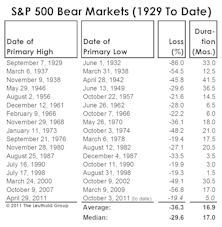
Bear Market Facts—A Refresher
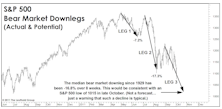
This month’s “Of Special Interest” examines the bear market facts. Doug Ramsey doesn’t expect the current bear market to reach historical bear market medians in terms of decline or duration. Non-economic bear markets are usually much shorter than recession-induced bears.
Recession Or No Recession? That ISN’T The Question
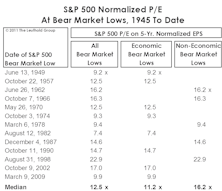
Doug Ramsey provides an analysis of non-recession related bear markets. Historically, non-recession related markets are shorter in duration than recession induced bear markets, but the decline is essentially the same magnitude.
Another Swoon Coming
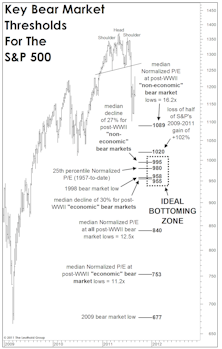
Several U.S. indexes and world stock markets have already lost 20% or more from recent peaks, satisfying the parameter for a bear market.
A Non-Economic Bear?
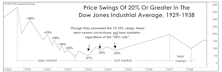
A market decline much beyond 20% could be labeled a “non-economic” bear market. Outstanding feature of past “non-economic” bear markets has been their brevity.
Bull Market Milestones: How the Current Bull Stacks Up to Past Cycles
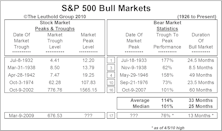
This month’s “Of Special Interest” examines the characteristics of past bull market recoveries. Using a variety of historical comparisons, the current recovery is put into some perspective. The majority of these comparisons seem to indicate the current recovery still has a ways to go.
“Secular” Is In The Eye Of The Beholder
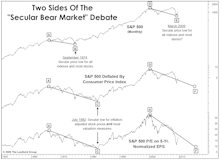
Secular versus Cyclical markets. It shouldn’t really matter. Investors can lose a lot waiting to be right. The Key is to focus on the cyclical movements within a secular bull or bear market.
Be A Buyer In An October Scare
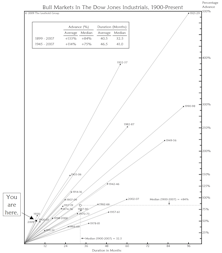
Following a strong September, October may be a little weaker. However, readers should use any October scare to buy equities in anticipation of strong end to 2009.
Has The Stock Market Come Too Far Too Fast?
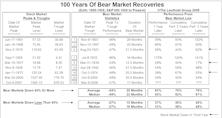
Lots of pundits calling for a double dip recession. In this month’s “Inside The Stock Market” Doug Ramsey questions their rationale and uses history as a guide to say that we don’t think so.
Perception for the Professional
March 2026 Issue

Featured Articles
Sector Navigator
March 2026 Issue