Articles by Phil Segner Sr. Research Analyst & Co-Portfolio Manager
Growth vs Value vs Cyclicals

Growth has outpaced Value in each market cap tier for five quarters in a row. Our Royal Blue High P/E Tier was the strongest performing segment of Q1 and outperformed the Low P/E Tier by a spread of 6.7%.
Small Cap vs Mid Cap vs Large Cap

Small Cap outperformance helped boost the Ratio of Ratios up from a 2% premium at the end of February. This is the first month our Large Cap P/E ratio has been below 20x since the end of April 2016.
Earnings Momentum

Our Up/Down Ratio sports a towering reading of 1.79, which is the highest our “three-month” ratio has been since the exit of the Great Recession.
Estimating the Downside - April 2018

Our monthly stock-slump streak has extended to two.
Additional Factors

Before rallying back to a more modest loss, the index was down 11.8% from its all-time high on January 26th. Also of note was the volatility—the index moved at least 1% in 12 of the 19 trading days. The S&P 500 had only experienced three 1% daily moves in the five months prior to February.
Growth vs Value vs Cyclicals

Outperforming in up, and now, down months, Growth stocks seem to have the best of both worlds. After an ugly February, Small and Mid Cap Value stocks are now in negative territory YTD.
Small Cap vs Mid Cap vs Large Cap

Despite dramatic Large Cap outperformance over the last five quarters, our Ratio of Ratios hasn’t strayed more than 4% from its long-term median Small Cap premium of 3%.
Earnings Momentum

Our Up/Down Ratio held on to its first month gains and now sports a “two-month” reading of 1.97. We’re experiencing a quantity of firms growing YOY EPS that is unmatched by recent history.
Estimating the Downside - March 2018

This multi-factor estimate of stock market risk is based on a regression to median stock market levels.
Inflation—Suddenly Relevant

The headline and Core CPI numbers for January both came in hotter than expected. Despite the resurrected interest and concerns about inflation we still haven’t caught inflation fever. Because of the narrative (correct or not) look for increased volatility surrounding inflation announcements.
Multiple Contraction—Just A Little Patience?
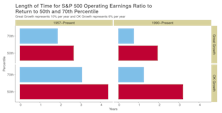
Things were bigger when you were a kid. Like that enormous sweatshirt your aunt gave you for your birthday or that hand-me-down ten-speed bike with the cross bar taller than your shoulders.
Additional Factors

January 2018 lived up to the hype in a big way as the S&P 500 turned in its best January performance since 1997.
Growth vs Value vs Cyclicals

Our Royal Blue Large Cap Growth names logged a decent “yearly” return in just one month (+9.4% in January). Value continued to lag across all market cap tiers.
Small Cap vs Mid Cap vs Large Cap

Thanks to some outsized outperformance in January, the median trailing P/E for our Large Cap decile rose from 21.5x to 22.5x while the measure for Small Caps remained virtually unchanged.
Earnings Momentum

Our Up/Down Ratio soared to an impressive reading of 2.65—nine years into the current recovery. This is the highest “one-month” reading we’ve seen since 1993.
Estimating the Downside - February 2018

This multi-factor estimate of stock market risk is based on a regression to median stock market levels.
S&P 500: Can You Hear The Steel Drums?

No volatility and only one (barely) down month—it was easy living for the S&P 500 in 2017. It was also a top-heavy year for the index. The largest five firms: AAPL, MSFT, AMZN, FB, and GOOG accounted for nearly a quarter of the index’s gain.
Growth vs Value vs Cyclicals

The pendulum swung Growth’s direction in 2017, erasing Value’s 2016 relative gains in the Large and Mid Cap tiers. Cyclical stocks also performed very well.
Small Cap vs Mid Cap vs Large Cap

After spending most of the year below our median long-term premium of 3%, our Ratio of Ratios has sprung back to where it started twelve months ago.
Earnings Momentum

Our Up/Down Ratio sports a “three-month” reading of 1.43—the worst full quarter figure of 2017. Above-trend earnings growth has not translated into above long-term average readings in our ratio.
Perception for the Professional
March 2026 Issue

Featured Articles
Sector Navigator
March 2026 Issue