Inside The Stock Market ...trends, cross-currents, and outlook
Sector Margins: Just Thank The Consumer
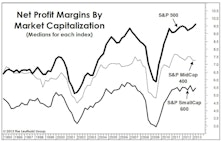
We’ve noted before that profit margin gains since the technology boom have been primarily a Large Cap phenomenon.
Navigating Reversals In The Emerging Markets
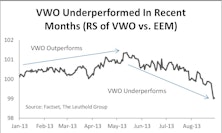
Identifying opportunities given this summer’s momentum reversals and currency vulnerabilities.
Bulled Over
The Major Trend Index has experienced a bout of instability since April, twice retreating to its Neutral zone before the bull market promptly overrode both signals.
The Economy And Earnings
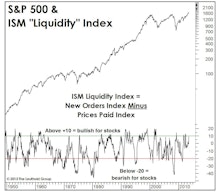
The YTD surge of 19% in the S&P 500 should ensure a stronger second half economy, and the big five-point jump in the latest Purchasing Managers Survey (ISM) might be the first evidence of this.
Two Bulls For The Price Of One?

IF one considers the 2011 decline a full-fledged bear market, then it follows the new bull market is only 22 months old. After all, we’re seeing some “immature” market behavior, and some atypical bear warnings.
“Immature” Market Behavior
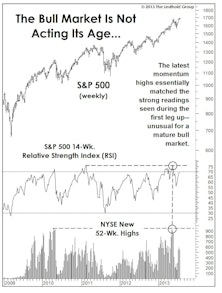
Whether one considers the post-2008 upswing two bull markets or one ultimately matters only to those who (like us) enjoy cataloging such things. But labeling the 2011-2013 rally a new bull market would certainly explain some of the “immature” behavior exhibited by U.S. stocks in recent months.
Not Your Typical Bear Warnings...
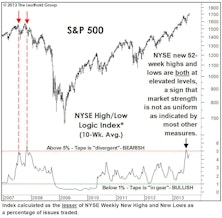
With July’s market surge producing new cyclical highs in virtually every important subgroup (other than Utilities), it’s difficult—if not dangerous—to question the U.S. stock market’s technical underpinnings.
Handicapping The High In Housing
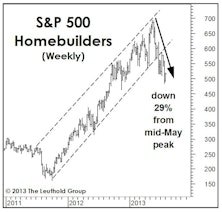
Today it seems taken for granted that the great housing meltdown of 2006-2010 was sufficient to purge the last decade’s excesses, and that housing can now be relied upon as one of the drivers of a slow but elongated U.S. economic expansion.
A New Leg In The Commodity Decline?
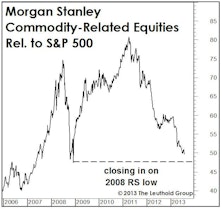
For more than two years we’ve discussed the supply-side risks to commodity producers stemming from capacity built during the manic “Third Act” of last decade’s Three Act Play in commodities. Commodity-oriented equities have indeed underperformed since 2011, but to date, most pundits have laid blame squarely on the demand side.
A Turn In Tech’s Tide?

Technology may be the biggest sector disappointment in the current eight-month leg of the rally, if not for the entire bull run from early 2009.
Two Valuation Metrics Still Bucking The Norm

With many (but not all) of our valuation metrics in overvalued territory, we present two histograms from our forthcoming quarterly BenchMarks publication that make the case that stocks are cheap (well, almost).
Major Trend Moves To Neutral, But Not All Hope For The Bulls Is Lost
Deteriorating Technicals drove the move to Neutral, but a new positive reading in the Attitudinal category gives some hope to the bulls.
Bonds & Cyclical Stocks “Decoupling”?
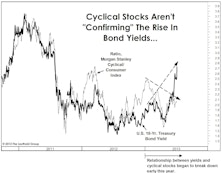
The relationship between U.S. Treasury bond yields and the relative performance of cyclical stocks versus their defensive consumer counterparts appears to be changing.
Gold’s Implications For Other Commodities
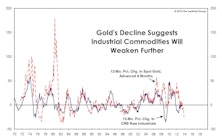
Gold’s recent weakness may be more ominous for industrial commodity investors.
Low Quality Continues To Outperform
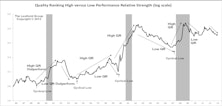
Despite rising market volatility, Low Quality stocks ended Q2 up 3.8%, slightly better than High Quality’s 3.4% gain. YTD, High Quality stocks are up 14%, just behind Low Quality stocks at +16.6%.
Target Date Funds Impacting Industry Fund Flows

Funds of funds, particularly target date funds, are growing rapidly and are now large enough to have a measurable impact on underlying fund flow trends.
A Contrarian Call For The Second Half

With the notable exception of the Consumer Discretionary sector, cyclical stocks topped out globally on a relative basis in early 2011 (Chart 3). Throughout the last two and one half years, there have been repeated calls for industrial cyclicals—which were, of course, the leaders of the last cyclical bull market—to reassume stock market leadership.
The Rolling Stock Market Top Of 2013 (… And 2011, 2010, And 2009)
We’ve frequently mentioned the two-faced nature of thematic leadership during the current bull market. Filtering out the minor swings, Phase One lasted from March 2009 through February 2011 and was dominated by low quality, high beta and cyclical stocks.
Market Internals: Today Vs. Past Peaks

The table below compares the status of today’s stock market “internals” versus those which existed at the onset of (1) the past four U.S. bear markets; and (2) the two severe corrections taking place within the current bull market. There’s good and bad news here.
Stocks And The Economy

We’ve written before about retail investors’ tendency to “conflate” stock market action with movements in the underlying economy. Misunderstanding this interrelationship generally causes the public to liquidate stocks when the economy is weak, only to ultimately buy them back when the economic recovery is obvious to all.
Perception for the Professional
May 2026 Issue

Featured Articles
Sector Navigator
May 2026 Issue