U.S. Dollar
U.S. Dollar—Still The Cleanest Dirty Shirt

The U.S. dollar broke below its recent support; its weakness has been a dominant driver of risky assets and its direction will be an important determinant of the current rally.
Tactical Tools For A Stronger Dollar
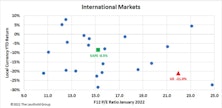
The 2022 bear market has been driven by collapsing valuation multiples, particularly for expensive growth stocks and unprofitable companies. Coming into the year, U.S. stocks stood as one of the most egregiously valued equity markets around the world, motivating investors to look elsewhere for more reasonably priced alternatives. Fortunately, international stock markets offered much better valuations that could serve as havens from the coming U.S. valuation collapse. Unfortunately, the strategy of seeking refuge in moderately priced foreign markets was foiled by an unusually strong U.S. dollar, leading us to take a closer look at how moves in the USD affect investment outcomes for domestic investors.
Research Preview: Returns In A Year Of Dollar Strength
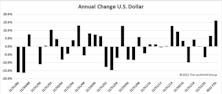
The U.S. Dollar Index (DXY) has gained 16.2% YTD, its best performance in almost 40 years. However, a strong dollar is bad for those with international investments, as returns are slashed when translated back into dollars.
U.S. Dollar—Drivers & Impacts

Most U.S. dollar drivers point to a stronger dollar: attractiveness of U.S. assets; policy differentials; real interest-rate differentials; terms of trade; weaker Yuan; and capital flows/hedging activity. Speculative positioning, however, is a negative and suggests the dollar rally might at least take a pause in the near term.
Gold: Still A Useful Dollar Hedge
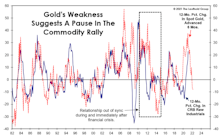
A stronger U.S. dollar is “supposed” to be bearish for commodities, but it’s been a banner year for most commodities with gold among the few that are down on the year. However, keep in mind that gold tends to be a harbinger of major moves in industrial commodities, with a lead time of about six months—and its year-over-year change is now negative.
Visualizing U.S. Stock Market Dominance
.jpg?fit=fillmax&w=222&bg=FFFFFF)
It’s near the year’s mid-point and U.S. equities are doing what they’ve done nearly every year since the onset of the Great Financial Crisis: trouncing their foreign counterparts. The S&P 500’s YTD gain of 13.5% is about 500 basis points better than EAFE’s, and 800 basis points above that of the MSCI Emerging Markets Index.
U.S. Dollar—A 2018 Redux?

The price action in the DXY Index over the last year shows an uncanny resemblance to the 2017-18 period, both in duration and magnitude. Overall, we believe the dollar could strengthen in the near term, but the longer-term bearish trend remains intact.
Keep An Eye On What Your Stocks Will Buy
.jpg?fit=fillmax&w=222&bg=FFFFFF)
News that the Bureau of Labor Statistics may have undercounted the May unemployment rate by six percentage points should remind investors of the danger of taking government economic reports too seriously. Regardless of the figure, though, unemployment is no doubt near its peak for the downturn.
No Place Like Home For The 2010s
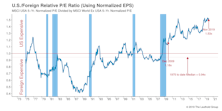
We thought we’d get a jump on all the “End of the 2010s” retrospectives you’re sure to see next month. Though not quite yet the official end of the decade, the changing of the “tens” digit definitely has a certain gravitas to it.
Is A Strengthening Dollar A Form Of Policy Tightening?
.jpg?fit=fillmax&w=222&bg=FFFFFF)
Executive summary (for those leaving early for the holiday weekend): No.
We’ve found no reliable relationship between swings in the U.S. Dollar and subsequent variations in U.S. economic growth.
Oil And The Dollar At New Highs: Is Something About To Give?
.jpg?fit=fillmax&w=222&bg=FFFFFF)
Crude oil and the U.S. Dollar Index accomplished a relatively rare feat by moving to simultaneous six-month highs earlier this week (Chart 1).
1999 Redux
As the market rebound has extended, we’ve noted its striking similarities with the rally of 1999—one that might have been the most speculative in U.S. history.
1987 Parallels (Part 2)
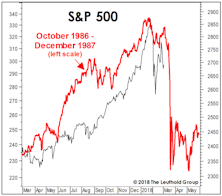
At the risk of yelling “fire” in a crowded theater, we present a few parallels between recent action and the year leading up to the October 1987 crash.
A Crude Catalyst?

The great mystery behind the trade-weighted dollar’s nearly-10% YTD decline is that it’s failed to fuel further gains (or any gains) in commodity prices in 2017.
Grappling With A Strong U.S. Dollar Outlook
.png?fit=fillmax&w=222&bg=FFFFFF)
Profitable investing overseas requires not one, but two, successful decisions: 1) select an outperforming asset class; and, 2) be in a currency that provides a favorable foreign exchange impact.
Global Configuration Of Bond Yields Supports Continued Bullish Dollar Stance

Contrary opinion theory is a valuable tool to investors, but today there are so many self-described contrarians that we sometimes struggle to identify what’s “consensus” and what’s “contrary.”
America’s Already First...

Thanks to the U.S. dollar’s recent spike, foreign equities in dollar terms declined during November while the U.S. markets were celebrating a Trump victory. Thirty-nine of the 49 MSCI country indexes are in bear market territory from the perspective of a dollar-based investor.
The Fed’s Capitulation To The Dovish Side— A Win-Win For EM & U.S.

We have mentioned a number of times that China had experienced a very unpleasant “second-hand” tightening due to its peg to the dollar. Its trade competitiveness has suffered tremendously. With a weaker dollar the Chinese Yuan can re-gain some of its competitiveness while maintaining its peg to the dollar. A rare win-win in today’s convoluted world of finance.
What’s Driving EM Currency Weakness?
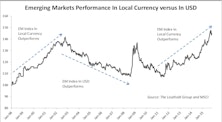
A strong dollar and low commodity prices are major forces dragging down EM currencies across the board.
What’s Next For The Dollar?
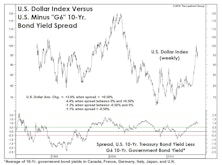
The U.S. Dollar Index has recovered about half the losses from a two-month, -7% setback from the 12-year peak it established in March.
Perception for the Professional
March 2026 Issue

Featured Articles
Sector Navigator
March 2026 Issue