Recession
Recessions & The Stock Market
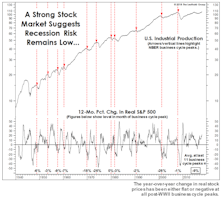
In the last couple of months, we’ve come across a handful of economic “check lists” purporting to show the relative absence of recession harbingers as the expansion closes in on its ninth anniversary this summer.
Stocks And The Economy
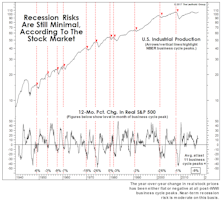
The stock market is often maligned as a poor economic forecaster, and it’s true the market has predicted several more recessions than have actually occurred.
Boom/Bust Doesn't Point to Recession
.png?fit=fillmax&w=222&bg=FFFFFF)
The Boom/Bust Indicator, combines a market-based measure (commodity prices) with a weekly government report on the employment situation
Recession Watch
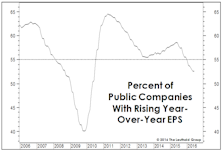
While we don’t see a U.S. recession on a one-year horizon, there are a handful of indicators that may force us to revisit that view—including the two relatively obscure data series shown below.
Recession? Too Early To Call
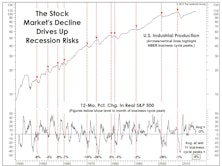
Among the various arguments put forward by those believing the recent decline is no more than a correction, the most difficult for us to address is the common claim that “there’s no recession on the horizon.”
Recession Or No Recession? That ISN’T The Question
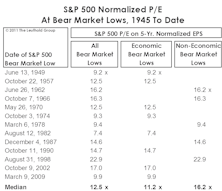
Doug Ramsey provides an analysis of non-recession related bear markets. Historically, non-recession related markets are shorter in duration than recession induced bear markets, but the decline is essentially the same magnitude.
Be A Buyer In An October Scare
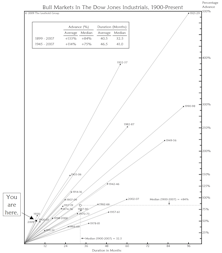
Following a strong September, October may be a little weaker. However, readers should use any October scare to buy equities in anticipation of strong end to 2009.
Lehman Remembered
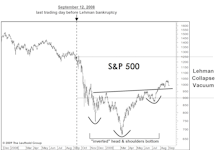
Market vacuum occurred during the 4 weeks following the collapse of Lehman Brothers, when the S&P 500 dove from 1250 to 900. This occurred during the recession, but it has been the Retailers that are among the few groups that have closed that gap.
November Market Action
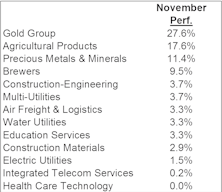
Drama, if not direction, have become one of the stock market’s few certainties.
Portraits Of Declining Inflation
Jim Floyd and Steve Leuthold believe that U.S. consumer price inflation has peaked and is headed for the +3% level by mid-2009. With current headline inflation running at +5.4%, that implies there is plenty of disinflation in the pipeline.
Financial Crises: A Historical Perspective
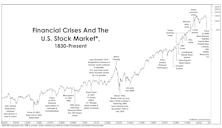
Doug Ramsey examines the history of bank failures and prior liquidity crises (back to 1830) to demonstrate that this current financial meltdown is not unprecedented. The names have changed, but the economic and emotional responses have been loosely patterned over the entire time frame.
The Beginning Of The End.....Yes, We’re Talking About The Bear Market
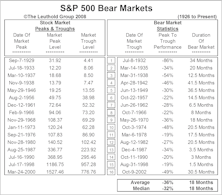
September was a horrible month for the stock market, but now is not the time to be selling stocks. We believe a market bottom is close at hand, and this month’s “Inside The Stock Market” section presents several of our “big picture”, historical market studies to provide support for this belief.
Economic Watch
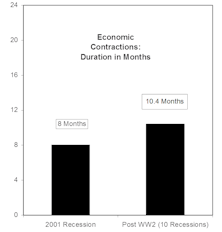
Even though government statistics do not yet indicate a declining quarter of real GDP growth, we believe we are, in fact, in the grip of a recession.
Trying To Make Sense Of Earnings
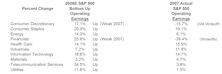
Jim Floyd tries to makes sense of earnings in the current recessionary environment.
Jobs/Consumer Data Flashing Recessionary Signals

Optimists have continuously cited low unemployment and the ever resilient U.S. consumer as two “pillars of strength” that will help keep the economy afloat. It has become considerably more difficult to make this case in recent months, as jobs and spending data have weakened to levels associated with recessions.
Bear Market Bottom This Summer?
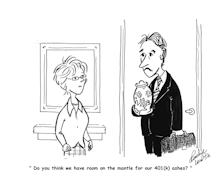
What follows is my attempt to accentuate the positive; why the current bear market may be maturing and bottoming out sooner than you might think.
U.S. Economy Skirts Recession In Q4, Or Does It?
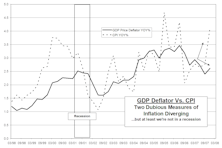
It now appears that the downward bias in inflationary pressures suggested by the CPI data is tame compared to the GDP Deflator. And if this is true, investors may be operating under a false sense of security that economic growth remains positive (albeit ever so slight).
Do You Believe In "Decoupling"

A popular buzz word in recent months is “decoupling”, often used in building a case for investing in fast growing foreign stock markets even though the U.S. economy is entering a phase of minimal economic growth or recession.
The Economy And The Stock Market
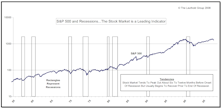
The stock market tends to peak out 6-12 months prior to recession but turns back up prior to the end of a recession.
View From The North Country

Steve's commentary on the stock market's Wall of Worry, the oil patch and mining company squeeze, the abusurdity of corn to ethanol and the world's most valuable companies.
Perception for the Professional
March 2026 Issue

Featured Articles
Sector Navigator
March 2026 Issue