Articles by Chun Wang Director of Multi-Asset Strategies
EM Crisis? Not There Yet

What some EM countries are going through is a classic sequence that can potentially lead to a full-blown EM crisis.
Inflation—Another Yawner
.jpg?fit=fillmax&w=222&bg=FFFFFF)
The year-over-year headline number was in line with market expectations. Inflation has taken a back seat to trade war and the market seems complacent about the potential impact of trade war. Trump is right to talk down the dollar as a stronger dollar is disinflationary.

Risk Aversion Index: A New “Lower Risk” Signal

Our Risk Aversion Index fell enough last month to generate a new “Lower Risk” signal. This is certainly not a “no brainer” risk-on signal. We recommend higher quality spread products within fixed income.
2018 Time Cycle—Mid-Year Update

2018 has been very atypical so far. But if the historical pattern is any guide, a near-term pull back should be expected in most equity markets, followed by nice year-end rallies.
Risk Barbell Or Middle Of The Road?

The underperformance of investment grade credit this year prompted the question of whether a risk-barbell portfolio of safe Treasuries and risky high-yield bonds may offer better performance than a middle-of-the-road portfolio of 100% investment grade corporate bonds in a highly-uncertain environment.
Inflation—Largely In Line
.jpg?fit=fillmax&w=222&bg=FFFFFF)
The year-over-year headline number was in line with market expectations but the month-over-month increase missed market consensus (0.1% vs. 0.2% expected). All else being equal, there is a good chance CPI might have peaked for 2018. A stronger dollar is disinflationary while the short term impact of tariffs is higher import prices.

Risk Aversion Index: Stayed On “Higher Risk” Signal

We believe the negative impact of central bank liquidity reduction is here to stay for the foreseeable future. We recommend defense within fixed income.
Investment Grade Widened More Than High Yield: Implications & More

As credit spreads widened, something rather unusual happened: investment grade Corporate bonds performed far worse than High Yield bonds.
Risk Aversion Index: Stayed On “Higher Risk” Signal

Volatility among non-equity asset classes has gone up noticeably while the VIX dipped lower. We still expect volatility to stay high and continue to play defense within fixed income.
All Crowded Trades Are Vulnerable—Even The Yield-Curve Flattener

Bond market volatility picked up quite a bit in May but the higher-low/higher-high pattern in the 10-year yield is still intact, indicating the primary uptrend has not reversed.
Inflation—A Small Miss
.jpg?fit=fillmax&w=222&bg=FFFFFF)
We have seen a string of in-line/slightly subpar inflation numbers (including wages) both here in the US and overseas. Two countervailing market forces are at work too: a resurgent dollar and higher oil/commodities prices. Financial conditions would tighten quite a bit if both the dollar and the real yields are up significantly.

Risk Aversion Index: Stayed On “Higher Risk” Signal

We expect volatility to stay high and still recommend defensive positions within fixed income.
Rates & Credit At A Major Crossroads—A Few Things To Watch
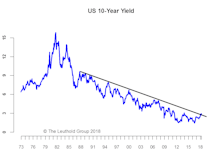
April saw a valiant attempt by the U.S. 10-year yield to crack the upper band of the multi-decade downtrend channel (around 3.0%-3.05%).
Inflation—No Break-out Yet
.jpg?fit=fillmax&w=222&bg=FFFFFF)
Despite the rare decline in the monthly reading, overall inflation trends are positive and in-line with expectations. A break-out on the upside has not happened yet. Inflation break-even rates are also well within the recent range. The overall picture for inflation is positive but uncertainties are higher.
U.S. Investment Grade Corporate Bonds: Maintain Neutral

Our overall view toward credit has turned decidedly cautious over the last couple months and that includes our long-term favorite.
Risk Aversion Index: Stayed On “Higher Risk” Signal

While concerns about a trade war might be easing and the credit market has been largely unaffected by the surge in Libor rates, we have to recognize the fact that Trump’s policy focus has become increasingly market-unfriendly while global central banks are in a liquidity-reducing mode.
Perception for the Professional
March 2026 Issue

Featured Articles
Sector Navigator
March 2026 Issue