Small Caps
The Valuation Case For “SMIDs”
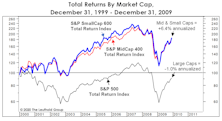
Mid and Small Cap stocks underperformed in 2018 and 2019. However, after the collapse of February and March, these “SMID” Caps have largely kept pace with the torrid rebound in the blue chips. Today’s valuations are priming the SMIDs for a similar “decoupling” in the years ahead, like that following Y2K.
Profiting From Mighty Mites
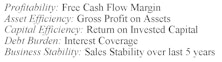
One of the signature traits of the U.S. small cap market is the prevalence of money losing companies. A recent tally indicated that prior to Covid, 38% of small caps were reporting trailing year losses despite the widespread economic strength of 2019.
The “Next Big Thing” May Not Be Big
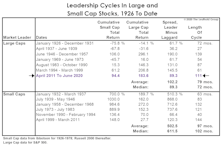
There’s one trend that’s lasted almost as long as the bull market and economic expansion and it hasn’t definitively come to an end. The current Large Cap Leadership Cycle hit the nine-year mark in April.
Preview: The Importance Of Quality In Small Caps
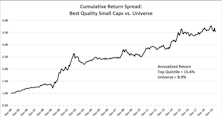
One of the signature traits of the U.S. small cap market is the prevalence of money-losing companies. Our recent tally indicates that even prior to COVID-19, 38% of small caps were reporting trailing year losses despite the widespread economic strength of 2019.
Revenge Of The Nerds?
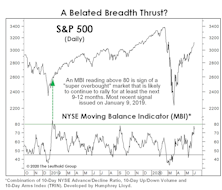
Last month we detailed two technical shortcomings of the rally off the March 23rd market low. The stock market duly noted our critique and has issued its response.
Money Losers Among Small-Cap Growth

Late last year, we presented data showing that profitability has become more elusive for small companies despite a record-long period of economic expansion. We discussed the potential causes underlying this phenomenon.
Small Cap Valuations: Zombies And Ragamuffins

Asset allocation decisions are fairly straightforward for groups of profitable and growing companies that fit nicely into a discounted cash flow model, but it is more difficult to describe the valuation of groups that include unprofitable companies.
Where Are The Leaders We Need?
Small Caps lagged during the bounce off the March lows before a late-April spurt briefly pulled them ahead of the S&P 500. Still, considering that Russell 2000 losses were so much steeper than the S&P 500’s (-43% versus -33%), we would have expected something better.
This Bounce Lacks “Oomph”
.jpg?fit=fillmax&w=222&bg=FFFFFF)
Through last night’s close, the S&P 500 had gained 25.0% in exactly one month. Impressive, but a bit superficial. Anyone running active equity portfolios recognizes the breadth of this move has been unusually narrow.
Are SMIDs Cheap Enough?
A composite measure of Mid Caps and Small Caps are at bottom-decile valuations relative to their 26-year histories. From a shorter-term viewpoint, though, we find it scary that valuations are so low just a single month into the recession.
Small Cap Smack-Down

We were fooled on Small Caps, and it’s been a “multi-factor” catastrophe.
Valuations: A “Progress” Report
.jpg?fit=fillmax&w=222&bg=FFFFFF)
As deep as the losses in the DJIA and S&P 500 have been, most professional investors recognize that those averages have masked the extent of the damage suffered by most stocks.
A Developing Opportunity In The “SMIDs?”
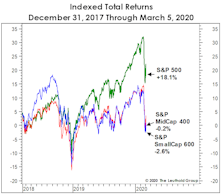
The underperformance of Mid and Small Caps in the last few years has taken valuations from top-decile readings (and, indeed, a few all-time records) just 25 months ago, down to the middle—and even lower reaches—of their 30-year valuation boundaries.
Small Cap Quality Check
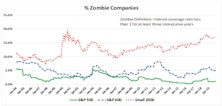
December’s Of Special Interest provided a recap of our Asset Allocation team’s view of small cap equities, suggesting that small caps had underperformed and reached a valuation discount that made them an interesting contrarian value proposition. Several clients responded with follow-up questions, wondering if the discount valuation of small caps was offset by their typically weaker business models.
Preview: Small Caps—Part 2

In response to client queries, we extended our research of small cap equities from last month. One angle we pursued was the relationship between small caps, quality, and business risk. The full report will be released mid-month.
A Small Cap Strategy Session
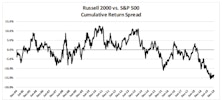
Leuthold’s research team has recently flagged a number of items that suggest it may be time to consider small cap stocks. This asset class has been showing signs of life and the decision to overweight small caps is starting to seem relevant – and perhaps nicely profitable - again.
A New Take On Small Cap Valuations
For valuation work, we’ve traditionally favored the 1,200 company Leuthold Small Cap universe over the S&P SmallCap 600 because we get almost a full additional decade of perspective. But figures for the latter shed extra light on just how significant the revaluation in Small Caps has been.
More Good News For Small Caps
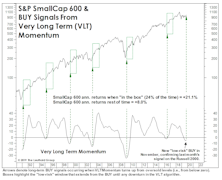
Our call for improved relative performance in Small Caps received another boost in November, when VLT Momentum for the S&P SmallCap 600 confirmed the prior month’s “low-risk” BUY signal on the Russell 2000.
How Will It Be Remembered?
A way to gain perspective on the present is by trying to view it from the future. Ask yourself, “What are the signs of impending decline, now ignored by investors, that will one day be memorialized by the same investors as the most obvious in retrospect?”
VLT Complicates The Market Puzzle

At October’s close, a long-term BUY signal was triggered on the Russell 2000. The fact that some market segments are triggering “oversold BUYS” when blue chips are at record highs speaks volumes about the internal disparities that have developed during the last few years. The Russell BUY signal is not inconsistent with our belief that the action since the January 2018 peak remains part of a lengthy cyclical topping process.
Perception for the Professional
March 2026 Issue

Featured Articles
Sector Navigator
March 2026 Issue