Seasonality
EM: The Case For Waiting...
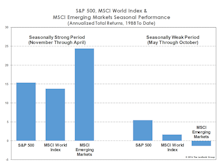
We’ve mentioned that concerns over potential seasonal weakness in September and October seem pronounced this year, perhaps because the year has so far turned out a pleasant surprise following its horrendous start.
Sell In May: Statistical Update
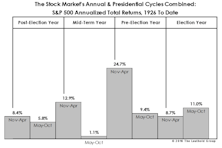
If this year’s interest in the “Sell In May” phenomenon is any indication, there remains plenty of skepticism surrounding the market’s recent rebound. The good news is that the “Sell In May” play has been weakest during presidential election years.
Year-End Rebound?
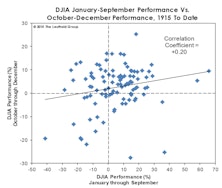
We reviewed 100 years of evidence for the Dow Jones Industrials Average and found no compelling evidence for a “bounce” effect. Contrary to expectations, fourth quarter Dow performance has (on average) been stronger when the index has already booked a gain through the first nine months.
It’s That Time Of The Year
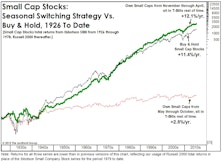
Seasonality rests one rung above witchcraft in the pecking order of respected analytical techniques, yet our studies haven’t been able to refute its validity. We simply don’t understand why calendar phenomena that have persisted for decades should still be around.
A Game Of ‘What If?’
Considering the Major Trend improvement, new bull market highs (Nov. 6th) on the S&P 500, DJIA, and DJ Transports, we present a list of talking points we’d use if forced to make a bullish stock market case.
The Worst Of The “Window” Is Upon Us
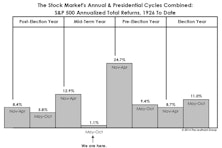
Three months ago, our “Of Special Interest” section reviewed the historically pronounced effect of the well-known “Sell In May” phenomenon during mid-term years of the presidential election cycle.
A Quick Take On Time Cycles
We stop short of embracing any sort of fixed stock market time cycle, but it's statistically difficult to discredit certain calendar patterns.
Sell in May
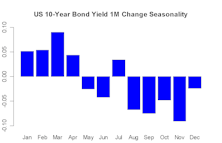
This does not only apply to stocks, it applies to just about all risky assets.
Market Internals: The Good And The Bad
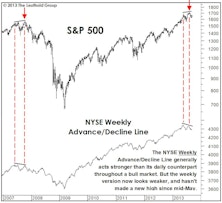
Leadership isn’t warning of impending weakness in either the U.S. economy or the stock market. Market breadth, on the other hand, is highlighting risks that aren’t evident when inspecting leadership alone.
What To Sell, If Selling In May
Those inclined to sell in May should sell Small Caps. If you don’t have Small Caps, sell Cyclicals, at least for the next six months.
Sell In May: Reformulated For The Fully-Invested
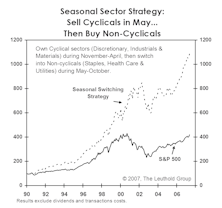
While the “Sell in May” market phenomenon has become part of Wall Street lore, the sector implications of this seasonal pattern are less well-known.
February 1st: Investors' Groundhog Day
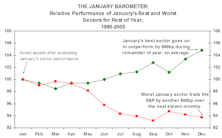
We wondered whether or not strong relative sector price action during January tended to persist for the remaining eleven months of the year. During the last 16 years, evidence proves that the strength does persist.
Is January Performance Predictive?
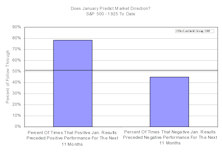
A look at the January barometer, indicates there is not much evidence that a weak January market portends weak performance in the remainder of the year.
January Effect: Now Tends To Arrive In December
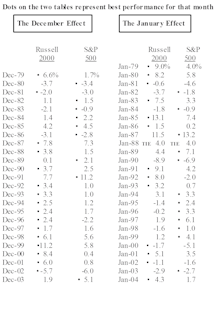
The January effect still lives…..it just comes a month earlier in December.
Into The Home Stretch…..2003
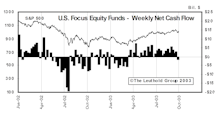
Octophobia 2003…..The stock market has nothing to fear but fear itself. The financial system is awash in liquidity, the economy stronger than anticipated and investor confidence is returning.
The Year That Was

Remain bullish on the stock market, but don’t expect Main Street to be a major stock market factor in 2003. Today’s bull market expectations for the DJIA, S&P, and NASDAQ.
A Disappointing Start
The “seasonals” were with us, but have yet to produce positive results. “V” shaped economic recovery conviction stronger than a month ago.
....The Year That Was

Looking Back: The best thing about 2001 is that it is over. Looking Forward: The seasons are with us as January is statistically the strongest month of the year.
April Is The "Opportunity" Month

Bear market broadened out in late March to include other than technology sectors. Never before have so many lost so much.…There is plenty of blame to go around. Academia, The Street, the Media, the “Experts” to name a few.
Big Caps Hot Out Of The Starting Blocks
It’s no secret that the term “January Effect” has taken on a different meaning in recent years. Once a reference to the price bounce that underperforming small caps stocks receive as year end selling pressures dissipate, it has now been adopted by commentators to describe the unconstrained rally of large cap stocks, as the seasonal flood of cash pouring into big cap growth funds is invested
Perception for the Professional
March 2026 Issue

Featured Articles
Sector Navigator
March 2026 Issue