Inside The Stock Market ...trends, cross-currents, and outlook
Small Cap Valuation Check

Small Caps have staged a nice rebound in the last several weeks. On July 3rd, the Russell 2000 rose to within a fraction of an index point of its March 4th all-time high. But on a relative strength basis, the bounce has been pretty muted.
Quality Stock Rankings: Low Quality Momentum Persists
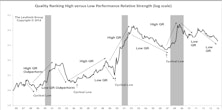
Low Quality Momentum persists, and a look at how Valuation factors affect the Quality model output.
Story-Telling Time

Great bull markets begin with numbers but end with narratives. The current bull market began with terrific statistics, but the past two years has given way to story-telling that is unimaginative even by Wall Street standards.
Transports Still Leading - Market Top Not Imminent
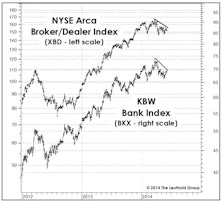
While stock market action YTD has not been quite as “uniform,” the hallmarks of an imminent bull market top are simply not present. The bullish portents apply to intermediate term results, however, they cannot rule out any short-term setbacks (which can appear with no tip-off from breadth or leadership measures).
The Volatility “Sweet Spot”

Daily stock market volatility has levitated at levels a bit higher than the VIX—in a zone that has historically been “optimal” for short-term performance.
“Overbought” Can Be Good Or Bad
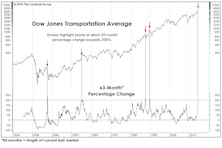
The notion of “overbought” and “oversold” markets might be the costliest concepts ever developed by stock market technicians. The very words imply some sort of excessive condition that’s prone to naturally self-correct.
The Tech Wreck That Wasn’t
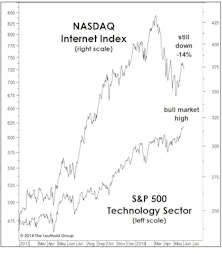
Although the social media darlings haven’t recouped their losses, the Technology Index moved to new cycle highs in early June.
QE: The Third Time Is The Charm

Five springs ago, we couldn’t have imagined we’d still hold near-maximum equity exposure after a near-tripling in the stock market from its Great Recession low. Then again, we wouldn’t have guessed that Fed printing presses would still be whirring so many years after the crisis ended. Coincidence? Probably not.
Commodities: Not A New Bull
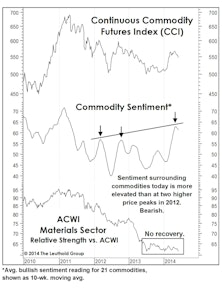
The year’s second biggest surprise (next to the relentless drop in bond yields) might be the YTD bounce in the major commodity indexes.
Just When You’d Stopped Worrying...

A good rule of thumb for fundamental forecasters is that projected events almost invariably take much longer than anticipated to occur, but then—once underway—unfold with much greater speed and power than originally expected (think subprime).
Dividend Paying Strategies—Which Is Best?

Timing a dividend strategy based on interest rate trends is futile. Look for quality of dividend payers for long-term success.
Distribution?
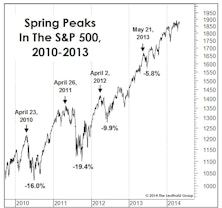
Small Cap weakness has many concluding that the terminal distribution phase is underway. We think that is a stretch.
Stock Market Observations

DJIA eclipsed its year-end closing high; Dow Transports still strong; NYSE A/D Line hits all-time high.
Small Cap Weakness Is Not A Market Death Knell
With Small Cap stocks falling to an 11-month RS low while the DJIA hits a new price high, many technicians point to this divergence as evidence the dangerous "distribution" period is underway. We're not so sure.
Party Like It's 1999?
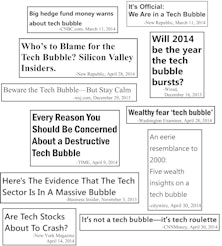
Over the last 6-months the "asset-bubble" label has been recklessly attached to Tech stocks. But that label is not right as the "Tech" decline has been concentrated in NASDAQ Internet Index names while the broad Tech sector is near an all-time high.
In Case You Missed Finance Class….
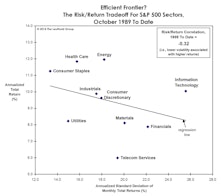
Modern Portfolio Theory debunked: since 1989, higher price volatility has generally been penalized with lower returns across the ten market sectors.
A Quick Take On Time Cycles

We stop short of embracing any sort of fixed stock market time cycle, but it's statistically difficult to discredit certain calendar patterns.
EM Sentiment Readings Reach Extremes

A few measures are suggesting that investor sentiment towards EM has reached a low ebb.
Time For A Spring Shower?
The stock market staged a two-day bearish reversal beginning a few hours after the release of the March employment report, a decline that could —based on the bearish status of a single MTI category (Attitudinal)—carry further before it is finished. But with the S&P 500 (and many other U.S. equity indexes) recording a bull market high as recently as April 2, it’s too early to argue the market top is “in.”
Perception for the Professional
May 2026 Issue

Featured Articles
Sector Navigator
May 2026 Issue