Defensives
Earnings Expectations: The Bear’s Other Shoe
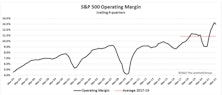
To paraphrase that great market historian Leo Tolstoy, “each bear market is unhappy in its own way.” Recession, interest rates, valuation bubbles, inflation, war, credit cycles, oil prices, manias & panics: the tipping point that triggers each bear market is always different. However, bearish forces ultimately manifest themselves in just two ways; declining earnings and/or declining valuations. June’s Of Special Interest report detailed how the current bear market has been fueled entirely by collapsing valuations, with the largest P/E compressions occurring in companies with the highest starting valuations.
Research Preview: The Impact Of Falling Estimates
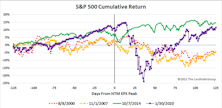
The 2022 bear market has been driven entirely by a collapse in P/E ratios. Last month, we noted that the other potential driver of market declines—falling earnings—had yet to raise its ugly head. Now we examine past episodes to consider how the stock market might react when the “other shoe” (EPS) drops.
Not The Leader We Wanted??
If many of the typical leaders of a new bull market aren’t leading, what is? Technology, obviously—and the bigger, the better.
Here’s One Reason Sentiment Is So Subdued...
.jpg?fit=fillmax&w=222&bg=FFFFFF)
Market bulls remain mystified by the lack of enthusiasm for stocks given the proximity of U.S. indexes to all-time highs. They view this relative indifference as a contrarian positive—the “wall of worry” argument.
Can Equity Investors Eat Their Cake And Have It Too?

Investor sentiment seems to be unusually conflicted these days. There are worries aplenty, including numerous political skirmishes of consequence around the world, a slowing global economy, and lofty U.S. equity valuations. On the other hand, fiscal stimulus is high for this stage in an economic cycle and the Fed is easing monetary policy, two policy drivers it rarely pays to bet against.
Leuthold Quick Takes: Getting Sentimental
This issue of Leuthold Quick Takes reviews the conflicted nature of investor sentiment as seen by Doug Ramsey (Chief Investment Officer) and Jim Paulsen (Chief Investment Strategist).
The Yin And Yang Of Utilities
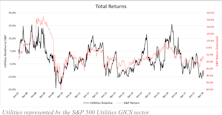
Are Utilities defensives, or are they interest rate plays, or both? We believe the driving influence fluctuates based on market conditions, specifically fear, and the desire for protection in down markets.
Defensive Equity Styles: The Sultan Of Swat And The Splendid Splinter

After performing amazingly well in the record-setting bull market run since 2009, defensive equities are once again drawing attention for their traditional role as hedges against a continuation of recent market declines.
What’s Ailing Consumer Staples?
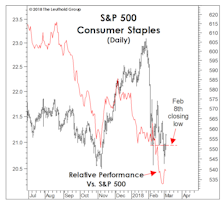
For the first time in this bull market, defensive stocks failed to provide any semblance of defense during a market correction.
The Many Faces Of Mo

Momentum is one of the most widely accepted alpha-generating factors, used by quantitative and fundamental managers alike. Its biggest drawback, however, is high turnover. Herein we explore momentum from the perspective of sector weights.
A Harbor In The Tempest

Our Major Trend Index (MTI) recently fell from “positive” toward stocks to a “neutral” reading, leading us to trim bullish equity positions in our tactical portfolios.
Defensive Positioning With Leuthold’s Groups

With the Major Trend Index now in “neutral” territory, and several well-known market strategists urging increased caution and risk awareness, we offer our perspective on defensive investing from the standpoint of our group work.
Is Defense Overpriced?
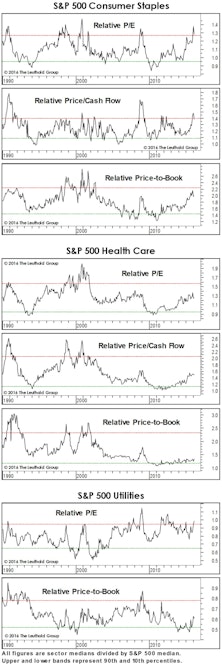
Relative valuations of Staples and Utilities sectors already reflect a “flight to quality” effect. Investors looking to add some economic/stock market defense should focus on the cheaper Health Care groups.
Where’s The Profit Leverage?

Industrial commodity prices and the latest ISM figures both point to a stabilization in the manufacturing sector following a two-year deceleration. Expectations for this year’s earnings have turned more optimistic as a result, but are the hopes warranted?
The EM "Trap"

2015 Leadership: An Early Take
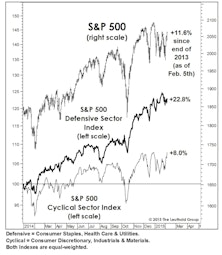
Last year’s economically defensive winners held their grip on stock market leadership in January. This action is consistent with our view that the bull market is an aged, overvalued one that has begun a final “distribution” process that will eventually erupt into a cyclical bear.
Sector Margin Trends

The S&P 500 record median profit margin of 10.3% is now almost a full percentage point above the last cycle’s peak of 9.4% (second quarter of 2007). Trends across S&P sectors are not as uniform as one might expect, though, with only half of the ten sectors last quarter at profitability levels that exceeded their 2001-2007 expansion highs.
The Surprising Winners In Emerging Markets

While we expect an eventual break in this relationship, today Emerging Market equities are following, fairly tightly, the cycle of industrial commodities—a cycle that rolled over (on a secular basis, we believe) in 2011.
Sectors: Where To Hide?

Much like the blue-chip indexes themselves, the cap-weighted S&P 500 sector indexes generally resisted the market mayhem erupting beneath the surface in September.
Defensive And Commodity Groups Improve

Two Consumer Staples groups upgraded to Attractive this month, Beverages and Tobacco. The Energy sector saw Integrated Oil & Gas upgraded to Attractive.
Perception for the Professional
March 2026 Issue

Featured Articles
Sector Navigator
March 2026 Issue