Cyclical Bear Market
Herd Instinct

Growth and Tech have been the flagrant winners YTD, yet the SVB crisis triggered further bifurcation: Since SVB failed, it’s been important to own only “big” Growth and “big” Technology, amplifying the multiples of monster stocks, like MSFT and AAPL. Can a major market low occur when investors are herded in a handful of the most richly-priced public companies in history?
Bear Market Rallies In Context
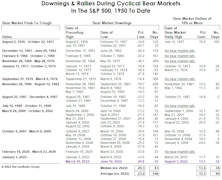
The 2022 bear market is the 13th cyclical bear since 1950, and it’s already joined the mightiest half of its predecessors based on the fact that it’s actually contained a bear-market rally. Six of the prior 12 bear markets weren’t interrupted by even one rally of at least 10%.
“Recessionary” Valuations?
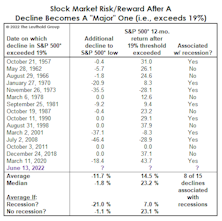
The bear was a mere cub back in March when we examined the historical record of buying S&P 500 dips in the -10% to -12% range. “Blindly” buying them turned out to have mediocre returns, but we illustrated that the positions of various business-cycle indicators could help one determine whether or not catching the proverbial “falling knife” was warranted.
A Stock Market Brain Teaser
The bull and bear labels can be dangerous to stock market operators, so much so that famed speculator Jesse Livermore is said to have abandoned them in favor of softer terminology: “Lines of least resistance.” We aren’t about to ditch the old labels, or even our collection of bull and bear bookends.
Where Are The Leaders We Need?
Small Caps lagged during the bounce off the March lows before a late-April spurt briefly pulled them ahead of the S&P 500. Still, considering that Russell 2000 losses were so much steeper than the S&P 500’s (-43% versus -33%), we would have expected something better.
Betting Against The Odds?
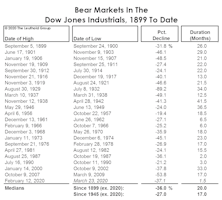
The optimists are betting that the longest bull market in history—one that carried valuations above levels seen at all but one of preceding cyclical peaks—has been followed by the shortest bear in history, at 27 days.
Did The 20% Bounce Kill The Bear?

We rolled our eyes when Barron’s and others proclaimed a “new bull market” after a three-day, 21% surge off the March low. That incredible bounce is much more likely to be the first of at least a few bear market rallies.
A “Best Case” Bear Scenario?
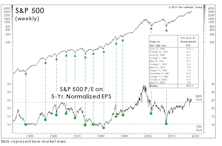
We intentionally curtailed our discussion of stock market valuations the last few months to allow the “dead horse” to recover from the thrashings administered in recent years. Now we’re rested, refreshed, and ready to deliver a few more lashes.
The Line Of Least Resistance Is Lower

At some point in his career, famed stock trader Jesse Livermore ceased using the terms bull and bear, opting instead to describe trends in terms of “lines of least resistance.”
Market Observations
.jpg?fit=fillmax&w=222&bg=FFFFFF)
It’s been one of the worst years on record for diversification, with our hypothetical All Asset No Authority (AANA) portfolio down 7.2% YTD through yesterday. That’s the second-worst year for AANA since 1972, and there’s probably not enough time left for performance to undercut 2008 (-24.9%) for the bottom spot.
Assessing The Damage
.jpg?fit=fillmax&w=222&bg=FFFFFF)
Our tactical accounts remain positioned very defensively, and we have yet to see the sort of capitulative market action that would lead us to lift any existing equity hedges.
Foreign Stocks “De-Coupling”

Market action has been broader and better than we expected given monetary conditions, and Small Cap strength seems to lend credence to contention that rates aren’t yet high enough to bite.
Bear Market Rally Or New Upswing?

Richard Russell—who wrote Dow Theory Letters for almost 60 years before his death last year—observed that “bear market rallies look better than the real thing.”
Labeling The New Up-Leg

The short-term market surge certainly possesses the hallmarks of many previous bear-killers (or correction-killers)…but it also sports the look of many historical bear market rallies.
Foreign Stocks Set For A New “Bear”-ing?

Based on comparative valuations alone, one could have made a case for investing in foreign stocks over domestic ones as early as 2010—when EAFE’s valuations sunk to an historical low, relative to the S&P 500. Today, that gap remains extreme.
Not A “Stealth” Decline Any Longer...
The most compelling evidence that a bear market is underway may not be what’s been punished (Transports, Small Caps), but what hasn’t. We believe the final bull market highs of any composite or sector index were recorded on December 29th.
Deciphering The Transports’ Message

The Dow Jones Transports was the first U.S. index to top in this cycle (December 31, 2014), and it closed January 7, 2016 down 24.1% from that historic high. That development, in and of itself, sharply increases the odds that a new cyclical bear market is underway.
TIME: The Hidden Market Risk?

Is there a statistical relationship between the height scaled by a given bull market and its subsequent decline? That correlation is in fact pretty tenuous, we’ve found.
Stock Market Observations
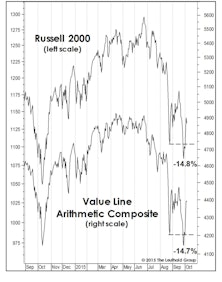
The August market break did not emerge from out of the blue. The foundation for the bear case was put in place many months before those four ugly days in late August.
More Trouble Ahead
Perception for the Professional
March 2026 Issue

Featured Articles
Sector Navigator
March 2026 Issue