Bridesmaid
Bridesmaid Strategy: A Value Alternative

For those not psychologically suited to a momentum approach, we’ve developed a contrarian sector allocation strategy that’s delivered even better long-term performance than the Bridesmaid approach.
Bridesmaid Strategy: Sector Track Record
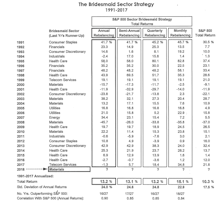
Table 3 shows annual performance results for the Bridesmaid sector strategy under all four rebalancing frequencies, along with the sector selection for the annual version of the strategy.
Bridesmaid Strategy: For Equity Managers

Our analysis of the Bridesmaid effect originated more than a decade ago, with an initial focus on equity sectors rather than asset classes.
Bridesmaid Strategy: Picking The Year’s Best Asset
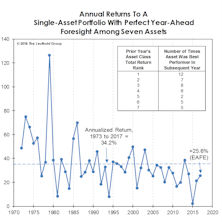
Here’s another way to look at the persistence of momentum across asset classes for the last 45 years.
Bridesmaid Strategy: Risk & Return
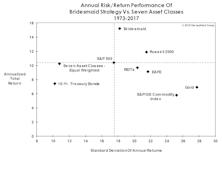
The concept of risk is hardly at the forefront of the investor psyche after the second-least volatile year in stock market history.
Bridesmaid Strategy: Track Record

Last year’s Bridesmaid gain of +21.8% matched the benchmark (obviously, since it was entirely invested in the benchmark).
Low P/E Sector: Annual Results
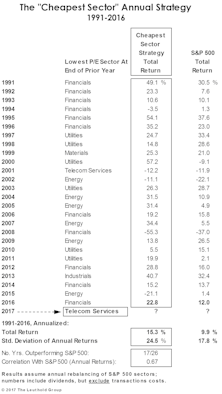
Table 6 summarizes annual sector selection and accompanying performance for the “Cheapest Sector” strategy back to 1991.
Bridesmaid Sector Track Record
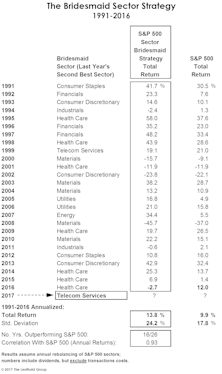
Table 4 shows the annual sector selection and accompanying performance results for the Bridesmaid approach dating back to 1991.
Bridesmaid Strategy For Equity Managers

Our analysis on the Bridesmaid effect originated back in 2006, but was initially based on equity sectors rather than asset classes.
Bridesmaid Strategy: Return Vs. Volatility
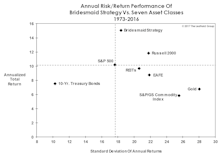
While the consideration of risk seems almost a quaint notion as the bull market nears its eighth birthday, it’s nonetheless worth noting the Bridesmaid allocation strategy has generated a favorable return/volatility trade-off in relation to: (1) the seven candidate asset classes; and, (2) the strategy of owning an asset class with a prior-year total return rank other than #2.
Bridesmaid Track Record
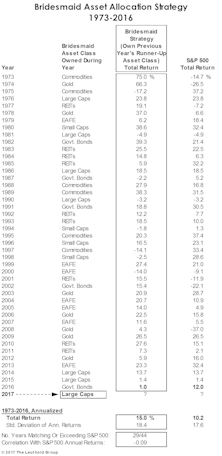
U.S. 10-Year Treasury Bonds—last year’s Bridesmaid holding—eked out a 1% gain in 2016, a disappointing result but one that preserved a streak of positive annual returns dating back to 2001 (Table 2).
Asset Allocation: Buy Strength Or Weakness?

The turn of the calendar seems to bring out the inner contrarian in some investors—those who will peruse last year’s list of lagging asset classes looking for rebound candidates.
Bridesmaid Asset Strategy
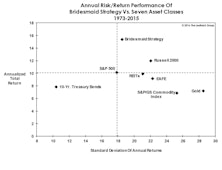
Liquidity “consuming” strategies like price momentum are generally considered to be more volatile than liquidity “providing” approaches like value investing.
Bridesmaid Sector Strategy
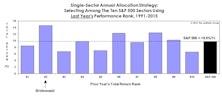
Our original research on price momentum dates back to the late 1960s, and was based not on asset classes but on equity sectors and industry groups. We stumbled upon the Bridesmaid effect, in fact, while testing a handful of simple strategies about a decade ago.
Asset Allocation & Sector Strategy: Follow The Trend, Or Fade It?
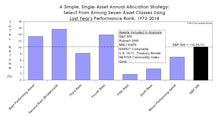
We are nothing if not contrarians, but have also highlighted the hazards of “knee-jerk” contrarianism—in which investors are instinctively drawn to the asset, sector, or stock that is down the most in price in the recent past.
Buy The Bridesmaid, Not The One Looking To Rebound
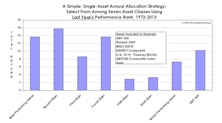
The investment leadership of a given year has historically had better-than-even odds of outperforming in the following year at both the asset class and equity sector levels.
Playing The Bounce - With A Twist
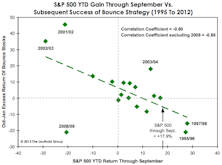
The historical batting average of this strategy has been decent, with gains in 9 of 18 years along with “excess” returns over the S&P 500 in 10 of 18 years. The best Bounce seasons have occurred when the market was either down for the year through September, or up only modestly.
Bridesmaid Revisited: Do You Buy Strength Or Weakness?
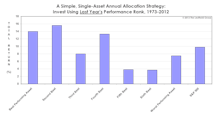
Our “second best really is best” analysis comes up with an asset class we like and a sector we hate, plus trying it monthly doesn’t work out quite the way we thought it would.
Buy Prior Year’s Winner, Loser, or Runner-Up?
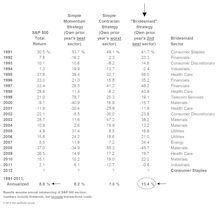
The best strategy has been to buy not the prior year’s top performing sector or asset class, but to buy the runners-up—or “Bridesmaids”— of the prior year.
Dreams, Nightmares & Bridesmaids: Should You Hold On To Last Year’s Winners?

Of Special Interest asks “Should You Hold On To Last Year’s Winners?” by examining the Dreams, Nightmares and Bridesmaid strategies. This year, our analysis expands beyond equity groups to the sector and asset class levels.
Perception for the Professional
March 2026 Issue

Featured Articles
Sector Navigator
March 2026 Issue