Bounce
A Bounce Without “Oomph”
One would think that one of the most explosive market rallies of all time would trip-off all the traditional “breadth thrust” signals, or maybe even invent a few of its own. Sorry, no luck.
2017 Was A Good Year For Playing The Bounce

The last two months of 2017 produced great results for the Bounce strategy.
Playing The Bounce: Does The November List Bounce?

We reconstituted the November and October “Bounce” screens back to 1986 and compared their average performance versus the “non-bounce” companies. Compared with the October list, the November list shows a much weaker bounce effect.
Playing The Bounce: The October List

Starting back in the early 1990s, The Leuthold Group began constructing and sending out an annual list of stocks that appeared to have been the subject of unusual selling pressure late in the year.
Year-End Rebound?
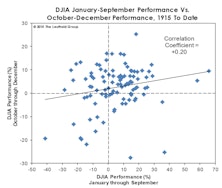
We reviewed 100 years of evidence for the Dow Jones Industrials Average and found no compelling evidence for a “bounce” effect. Contrary to expectations, fourth quarter Dow performance has (on average) been stronger when the index has already booked a gain through the first nine months.
A Good Year To Play The Bounce?

Our research shows that the best years to “Play The Bounce” are generally ones in which the stock market is heading down into the fourth quarter. We won’t rule out an allocation to the Bounce strategy in the weeks ahead.

A Forgettable “Bounce” Season
The last few innings of a cyclical bull market generally favor trend or momentum-oriented strategies, rather than mean-reverting ones like “Playing The Bounce."
January Anomalies Revisited
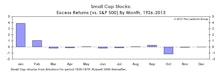
The January Small Cap bounce effect ain’t what it used to be, but extrapolating the month’s market action for the next eleven months is a “less bad” idea than any other time of the year.
Playing The Bounce - With A Twist
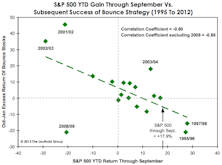
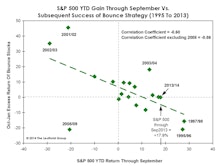
The historical batting average of this strategy has been decent, with gains in 9 of 18 years along with “excess” returns over the S&P 500 in 10 of 18 years. The best Bounce seasons have occurred when the market was either down for the year through September, or up only modestly.
Playing The Bounce: November Screen

Our annual screen presents the candidates with the largest declines and smallest rebounds, thus far, in each market cap segment.
Playing The Bounce: Last Screen Of The Season & Historical Results
The last screen of 2011 is presented and historical November Bounce screen results are detailed.
Playing The Bounce: New Methodology And Backtesting

A new screening methodology for Leuthold’s traditional “Playing The Bounce” screen is presented and examined.
Playing The Bounce 2010—Final Scorecard

As we expected, it was not a memorable “Playing The Bounce” year.
Playing The Bounce 2010—Final Update

As we expected, it was not a very good “Playing The Bounce” year. Many fund managers still had substantial tax loss carry forwards which they used to offset 2010 gains.
Playing The Bounce Update

It does not look like a very good “Playing The Bounce” year. Many fund managers still have substantial tax loss carry forwards they can use to offset this year’s gains.
Playing The Bounce Update

Not much happening with this year’s edition of “Playing The Bounce.” Initial list of qualifiers posted a loss of 1% in October, while the S&P 500 was up 3.7%.
Playing The Bounce Strategy 2010: Individual Stocks and Equity Groups
“Playing The Bounce” season is once again upon us. This is a tactical trading strategy designed to identify beaten-down stocks which come under heavy selling pressure at year end. When selling abates, stocks tend to “bounce.”
Playing The Bounce 2009—Most Of The Market Has Already Bounced

Most stocks, especially low quality stocks, have already bounced so there will be no Playing The Bounce strategy this year.
Playing The Bounce: No Carry Through In January After Strong December

A last look at a dismal year for Playing the Bounce.
Perception for the Professional
March 2026 Issue

Featured Articles
Sector Navigator
March 2026 Issue